Port-to-Port Freight Forwarding China to USA: Costs and Scope
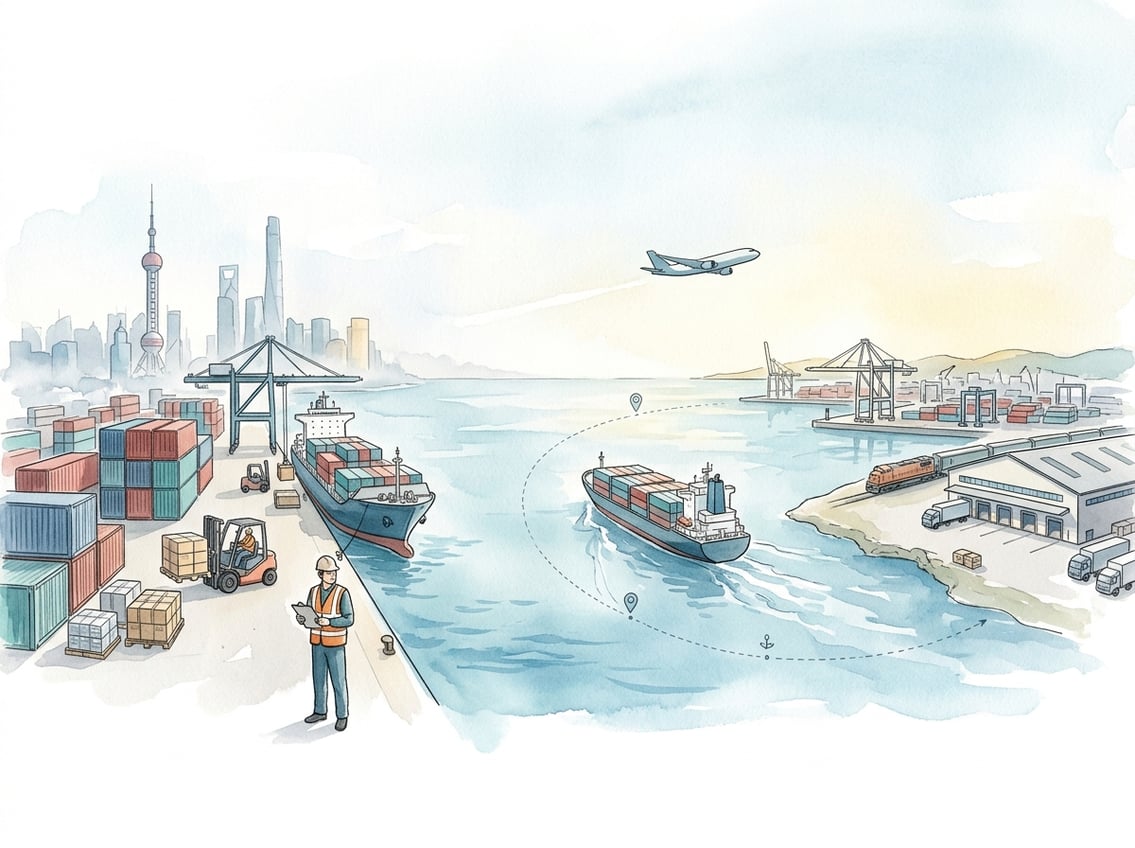
Port-to-port freight forwarding moves your cargo by ocean from a loading port in China to a discharge port in the USA. Nothing is arranged at either end. AEB Logistics books this ocean leg for importers who already have a customs broker and trucking lined up on the U.S. side and want a straightforward port-to-port ocean freight rate without paying for services they don’t need.
As an experienced freight forwarder China to USA, we handle the booking, documentation, and tracking between the two ports. Factory pickup, export customs, U.S. import clearance, and inland delivery stay outside the quote unless you ask us to add them. Shipping from China to the USA this way keeps your operational expenses focused strictly on the water transit.
This setup works well for import teams that already manage their own customs and trucking operations and just need a reliable ocean freight booking. It also suits anyone comparing total landed costs across shipping options before deciding how much to hand off.
We’ve coordinated this kind of shipment for importers moving everything from industrial equipment to retail goods between Chinese export hubs and U.S. gateway ports. Knowing which charges the quote covers and which show up later at the terminal can mean the difference between a clean booking and a surprise invoice.
Contents hide
1 How Much Does Port-to-Port Shipping Cost?
1.1 What Should a Port-to-Port Freight Quote Include?
1.2 Which Charges Can Arise at the Destination Port?
1.3 What Details Does AEB Logistics Need for an Accurate Quote?
2 What Does AEB Logistics Handle Between China and U.S. Ports?
2.1 Ocean Freight Options: Full Container Load or Less than Container Load
2.2 Origin Port, Destination Port, and Cargo Handoffs
2.3 Services Available Beyond the Port-to-Port Quote
3 Who Handles Customs, Documents, and Port Handoffs?
3.1 Importer of Record, Customs Broker, and Duty Responsibilities
3.2 Documents and Filing Information to Prepare Before Departure
3.3 How FOB, CIF, FAS, and DDP Change the Scope of Service
4 How AEB Logistics Plans and Coordinates Your Shipment
4.1 Matching Container Space and Routing to Your Cargo
4.2 Coordinating Booking, Documentation, and Tracking
4.3 Arranging Optional Inland Delivery or Warehousing
5 Why Trust AEB Logistics With Your China-to-USA Freight?
5.1 China Shipping Expertise and a Dedicated Point of Contact
5.2 Company Registration and Relevant Credentials
5.3 Case Study Reference: Request a Relevant Shipment Example
6.1 What is included in port-to-port freight forwarding from China to the USA?
6.2 How much does port-to-port ocean freight from China to the USA cost?
6.3 Which China and U.S. ports can my shipment use?
6.4 Do I need my own customs broker for a port-to-port shipment?
6.5 Can AEB Logistics arrange pickup or delivery beyond the ports?
RELATED Freight Forwarding from China Ports to the USA | AEB Logistics
How Much Does Port-to-Port Shipping Cost?
Port-to-port ocean freight rates depend on container size, origin port, destination port, and the time of year you book. A 20-foot container moving to the U.S. West Coast typically costs less than the same container routed to the East Coast, where longer routes add transit time and distance.
Rates also shift with carrier capacity. During peak shipping months, carriers add peak season surcharges to the base ocean freight rate, and these can change the total more than people expect.
Don’t mistake a port-to-port quote for your full shipping cost. It covers only the ocean leg, so you’ll still need to add origin charges, destination charges, and customs brokerage to calculate your total landed cost.
What Should a Port-to-Port Freight Quote Include?
A port-to-port freight quote should spell out the base ocean freight rate, container type, port pair, and any carrier surcharges tied to the sailing. We list these separately instead of rolling them into one number, so you know exactly what the ocean carrier is charging before you book.
What a port-to-port quote leaves out matters just as much. Factory pickup, export documentation in China, import customs clearance, duties, and inland trucking at destination aren’t part of this scope. If your freight forwarder’s quote already includes those items, you are looking at door-to-door shipping rather than a port-to-port quote.
Which Charges Can Arise at the Destination Port?
The U.S. port bills terminal handling charges separately from the ocean freight rate once it unloads your container. Demurrage charges apply if the container stays at the terminal past its free time, while detention charges apply if you keep the carrier’s container or chassis longer than allowed.
The port and carrier set their own free-time windows, separate from your customs clearance timeline. A customs delay on your end can trigger demurrage even if the ocean freight arrives on schedule.
We list these as separate charges when we quote a shipment, so you can plan your customs and drayage timing around them instead of discovering them after the container lands.
What Details Does AEB Logistics Need for an Accurate Quote?
To prepare an accurate freight quote, we need your origin and destination ports, the Incoterm you’re shipping under (FOB or EXW, for example), your cargo’s HS code and value, and its box count, cubic meters, and weight. We also ask for your estimated cargo-ready date because sailing schedules and rates shift around it.
The more specific your information, the fewer surprises you’ll face when your shipping quote turns into a booking. Vague weights or missing HS codes are the most common reasons a quoted rate changes later.
RELATED Door-to-Door Freight Forwarder China to USA | AEB Logistics
What Does AEB Logistics Handle Between China and U.S. Ports?
AEB Logistics manages the ocean freight booking, export documentation at origin, and tracking updates from the time your cargo loads until it reaches the U.S. port of discharge. That’s the core of port-to-port service: we book your container or cargo space, get it loaded, and move it reliably across the Pacific.
We coordinate sea freight for full container load and less than container load (LCL) shipments from major Chinese export hubs. We manage the ocean carrier booking and bill of lading details to make sure paperwork matches what gets loaded. While urgent parcels move by express courier or air freight under an air waybill, ocean transit delivers significant volume savings.
Ocean Freight Options: Full Container Load or Less than Container Load
Full container load (FCL) gives your cargo a dedicated container in 20-foot, 40-foot, and 40-foot high-cube sizes. It suits large shipments or cargo that needs tighter security, since no one opens the container for consolidation along the way.
LCL shipping fits smaller or test-order volumes that don’t fill a container. We consolidate your cargo with other shipments heading to the same U.S. port, so you pay for the space you use rather than a full container rate. LCL freight requires deconsolidation at a container freight station on arrival, adding a step before your cargo clears customs.
Origin Port, Destination Port, and Cargo Handoffs
Your choice of China origin port and U.S. destination port affects transit time and cost more than most importers expect. We coordinate pickup and export handling from suppliers near Qingdao, Shanghai, Shenzhen, and Ningbo, then route cargo through the port that best fits the supplier’s location and sailing schedule.
West Coast ports like Los Angeles and Long Beach generally offer shorter ocean transit. East Coast ports such as New York/New Jersey make more sense for cargo headed to eastern distribution points. We schedule each handoff, from factory to origin port and vessel to destination terminal, to keep the container from sitting idle.
Services Available Beyond the Port-to-Port Quote
We can add factory pickup, customs brokerage, inland trucking, and final-mile delivery to a port-to-port booking. We quote each service separately so you can decide how much of the shipment to manage yourself and how much to hand to us.
If you’d rather have one provider carry the shipment from the supplier’s door to your own, our door-to-door freight forwarder service covers that full scope instead. Importers can also rely on our 3PL solutions for inventory sorting and short-term holding.
RELATED Freight forwarding from China to USA: How to Choose a China to USA Freight Forwarder?
Who Handles Customs, Documents, and Port Handoffs?
The importer handles customs clearance on a port-to-port shipment unless you’ve arranged brokerage separately through AEB Logistics. A freight forwarder moves the physical cargo; a licensed customs broker files the entry with U.S. Customs and Border Protection. They’re not the same role.
Getting the documentation right before departure prevents most of the delays we see at U.S. ports.
Importer of Record, Customs Broker, and Duty Responsibilities
The Importer of Record is legally responsible for the accuracy of the customs entry, including classification, value, and duty payment. You need to name a business or individual before the cargo ships, not after it arrives.
A customs broker can file the entry on the importer’s behalf, but first needs a signed power of attorney from the importer. When requested, we can coordinate customs brokerage as part of your shipment. This service usually costs around USD 125, depending on the number of commodities on the entry. Note that AEB Logistics does not act as Importer of Record; that responsibility stays with the importing business.
Documents and Filing Information to Prepare Before Departure
Every port-to-port shipment needs a matching commercial invoice, packing list, and bill of lading before the cargo loads. Make sure all three documents agree on carton counts, weights, and product descriptions. A mismatch is one of the fastest ways to trigger extra scrutiny at the U.S. port.
Your HS code, called an HTSUS code once matched to the U.S. tariff schedule, determines the duty rate applied at entry. Many goods from China also carry Section 301 tariffs on top of the standard rate, so both the code and country of origin affect what you’ll owe. Once we have your shipment details, we can provide HS/HTS code guidance and import duty estimation support.
How FOB, CIF, FAS, and DDP Change the Scope of Service
Under FOB shipping, your supplier covers origin costs up to loading on the vessel at the China port, and you take over from there. With FAS (Free Alongside Ship), the seller delivers goods alongside the vessel at the port, leaving loading and sea freight to the buyer. FOB pairs naturally with port-to-port bookings.
CIF (Cost, Insurance, and Freight) means the supplier arranges the ocean freight and insurance, but you still handle customs and delivery at the U.S. end.
DDP shipping has a different scope entirely. Under DDP (Delivered Duty Paid), the seller or freight forwarder covers duties, taxes, and clearance all the way to a named destination warehouse. Confirm which Incoterm applies to your purchase order before requesting a quote, since it dictates AEB Logistics’ operational scope.
RELATED China to USA Door-to-Door Freight Forwarder | AEB Logistics
How AEB Logistics Plans and Coordinates Your Shipment
AEB Logistics plans each port-to-port shipment around your cargo volume, routing, and cargo-ready date, then tracks it from booking through arrival at the U.S. port. One account manager handles your shipment, so it doesn’t get passed between departments.
Matching Container Space and Routing to Your Cargo
We start container size and routing decisions with your cargo’s cubic meters, weight, and fragility. We can help you decide whether your volume justifies a dedicated FCL container or fits better as LCL shipping, consolidated with other cargo bound for the same U.S. port.
Routing also depends on your supplier’s location. A supplier near Shenzhen shipping through a southern China port can often reach the U.S. faster than cargo rerouted through a northern port for convenience.
Coordinating Booking, Documentation, and Tracking
Once we set the routing, we handle the carrier booking, bill of lading issuance, and export documentation. Then we track the shipment through the carrier’s system as it moves. We monitor milestones such as accepted, in transit, export customs, export departure, import entry, import arrival, and delivered.
You can request cargo insurance for the ocean leg to cover loss or damage during transit. We recommend it for higher-value cargo because international shipping conventions limit ocean carrier liability, which rarely covers the full replacement value.
Arranging Optional Inland Delivery or Warehousing
Importers who want to extend the scope beyond port-to-port can add inland trucking, transloading, and warehousing and distribution once their container clears the U.S. port. We can arrange final-mile delivery to a warehouse or distribution point through our trucking partners, rather than company-owned trucks.
Ready to lock in a port-to-port rate? Request a free shipping quote through our dashboard or email support@aeblogistics.com with your origin and destination ports, Incoterm, cargo details, and cargo-ready date. We’ll return an itemized proposal.
RELATED Freight Forwarder China To USA: Essential Guide For Efficient International Shipping
Why Trust AEB Logistics With Your China-to-USA Freight?
AEB Logistics brings more than 20 years of experience shipping from China to every port-to-port booking. Alan Fan, a former global carrier executive, leads the company. His background shapes how we quote and track shipments, with full visibility into carrier behavior and terminal processes on both sides of the Pacific.
China Shipping Expertise and a Dedicated Point of Contact
We assign one account manager to every shipment to handle booking questions, documentation, and tracking updates from start to finish. Small and medium-sized businesses working with us won’t get passed between departments when a question comes up mid-shipment.
As a China to USA freight forwarder, we work across major export hubs including Qingdao, Shanghai, Shenzhen, and Ningbo. That gives us direct familiarity with how cargo-ready dates and port congestion play out at each location. It matters for timely delivery planning because sailing schedules out of different ports can look very different in the same week.
Company Registration and Relevant Credentials
AEB Logistics is a legally registered logistics company in China. It operates under the entity 青岛安柏物流有限公司 with Unified Social Credit Code 91370200595265664M. You can verify this registration through China’s National Enterprise Credit Information Publicity System at gsxt.gov.cn.
We’re also a member of the Amazon Service Provider Network (SPN), reflecting our work coordinating Amazon FBA shipping alongside standard port-to-port moves. Importers can compare our ocean options with Amazon Global Logistics to evaluate transit windows and costs. For marketplace sellers, we can also manage carton prep and FNSKU labeling before goods enter fulfillment centers.
Case Study Reference: Request a Relevant Shipment Example
We’ve coordinated full container load ocean freight shipments from Chinese ports like Yantian to U.S. destinations. These shipments have included booking, bill of lading issuance, cargo insurance, and U.S. entry filing for the consignee. If you’d like to see how we handled a shipment similar to yours from start to finish, our team can walk you through an example when you request your quote.
RELATED China to USA Freight Forwarding: Port-to-Port, DDP, and FBA
Frequently Asked Questions
What is included in port-to-port freight forwarding from China to the USA?
Port-to-port service covers ocean freight booking, export documentation, and transport from the port of origin in China to the destination port in the U.S. It doesn’t include factory pickup, customs clearance, duties, or inland delivery unless you add those services separately.
How much does port-to-port ocean freight from China to the USA cost?
The cost depends on container size, the ports involved, and carrier capacity when you book. East Coast routes generally cost more than West Coast routes because of the added transit distance. Peak season surcharges can also raise rates during high-demand months. Request a quote with your cargo details for an accurate price.
Which China and U.S. ports can my shipment use?
AEB Logistics coordinates pickup and export handling near Qingdao, Shanghai, Shenzhen, and Ningbo. Shipments can route into U.S. gateways such as Los Angeles, Long Beach, and New York/New Jersey. The right port pair depends on your supplier’s location and your final U.S. delivery point.
Do I need my own customs broker for a port-to-port shipment?
Yes, unless you ask AEB Logistics to coordinate customs brokerage as an add-on to your booking. Port-to-port service assumes you already have a customs broker and Importer of Record arrangement in place on the U.S. side.
Can AEB Logistics arrange pickup or delivery beyond the ports?
Yes, we can arrange factory pickup, inland trucking, warehousing, and final-mile delivery as additional services beyond the port-to-port quote. These options turn the shipment into a door-to-door arrangement, which we quote separately from the ocean freight leg.
Related Posts
About the author
- Freight forwarder, led by Alan Fan, a former global carrier executive with 20+ years in shipping from China.
Comments
Join the discussionNo comments yet. Be the first to comment.
Shipping China to USA
Explore AEB Logistics’ trusted services for shipping China to USA. Get expert support, competitive rates, and smooth customs clearance.