Key Differences In China To USA Freight Forwarders
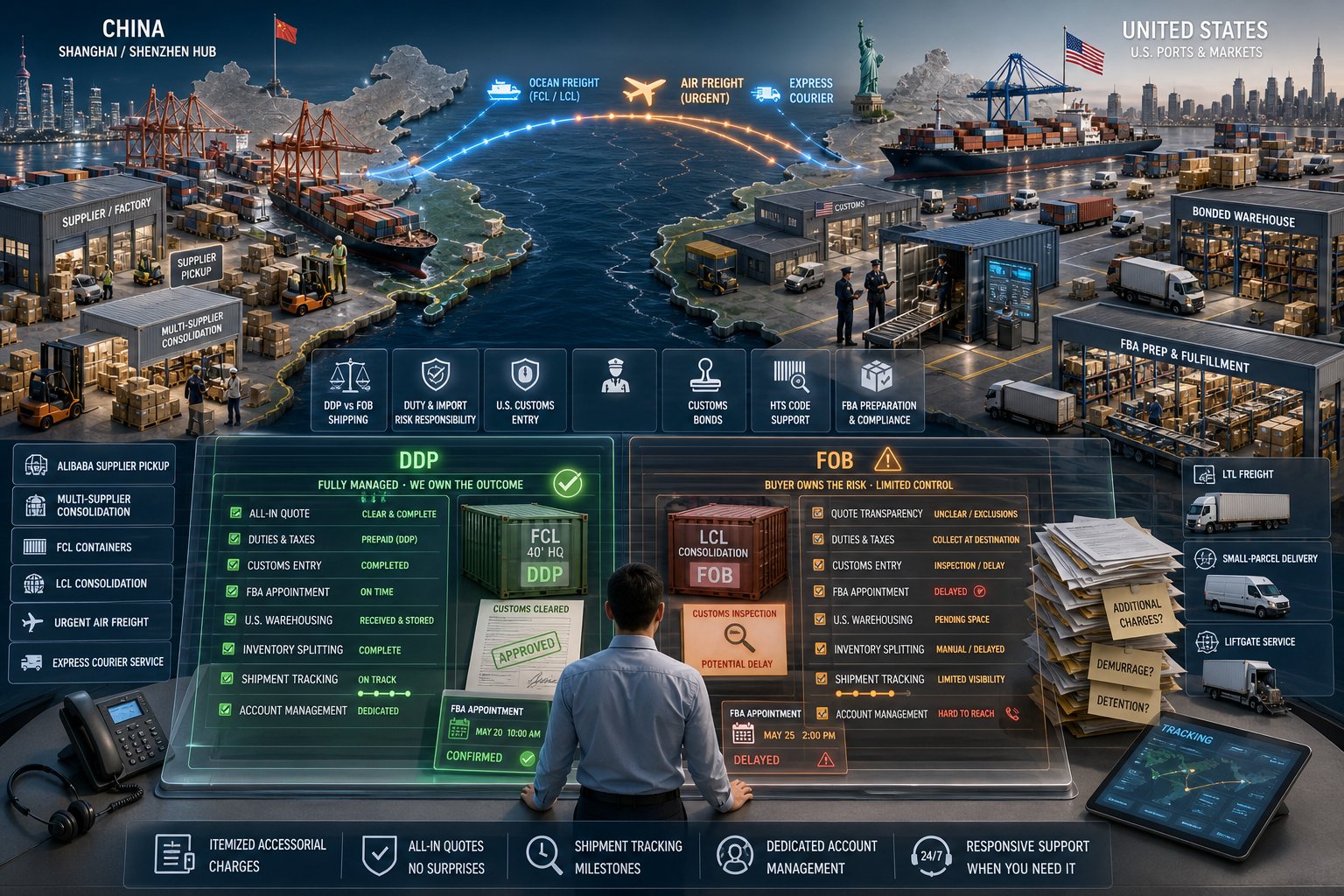
Every China to USA freight forwarding quote looks about the same at first glance. Ocean rate, air rate, delivery estimate—it all blurs together.
But the real differences pop up once your cargo’s moving and a decision needs to be made. Who pays the duty? Who books the Amazon appointment? Who actually picks up the phone when your container gets flagged for inspection?
The biggest gap between freight forwarders isn’t price—it’s who owns each step of your shipment and who you call when things go sideways. This comparison digs into the operational choices that can make your import smooth or, honestly, a headache.
Whether you’re sourcing through Alibaba for the first time or ramping up a recurring FBA supply chain, these are the questions you should ask before you book.
Contents hide
1 DDP Shipping Vs. FOB Shipping: Who Controls Duties And Import Risk
2 U.S. Customs Entry, Customs Bonds, And HTS Code Support
3 Amazon FBA Prep: FNSKU Labels, Carton Labels, And Delivery Appointments
4 U.S. Warehousing: Receiving, Transload, Storage, And Inventory Splitting
5 FCL Containers Vs. LCL Consolidation For China-To-USA Ocean Freight
6 Air Freight Vs. Express Courier For Urgent China-To-USA Shipments
7 Alibaba Supplier Pickup And Multi-Supplier Cargo Consolidation
8 Amazon FBA Last Mile: LTL Freight, Small Parcel Delivery, And Liftgate Service
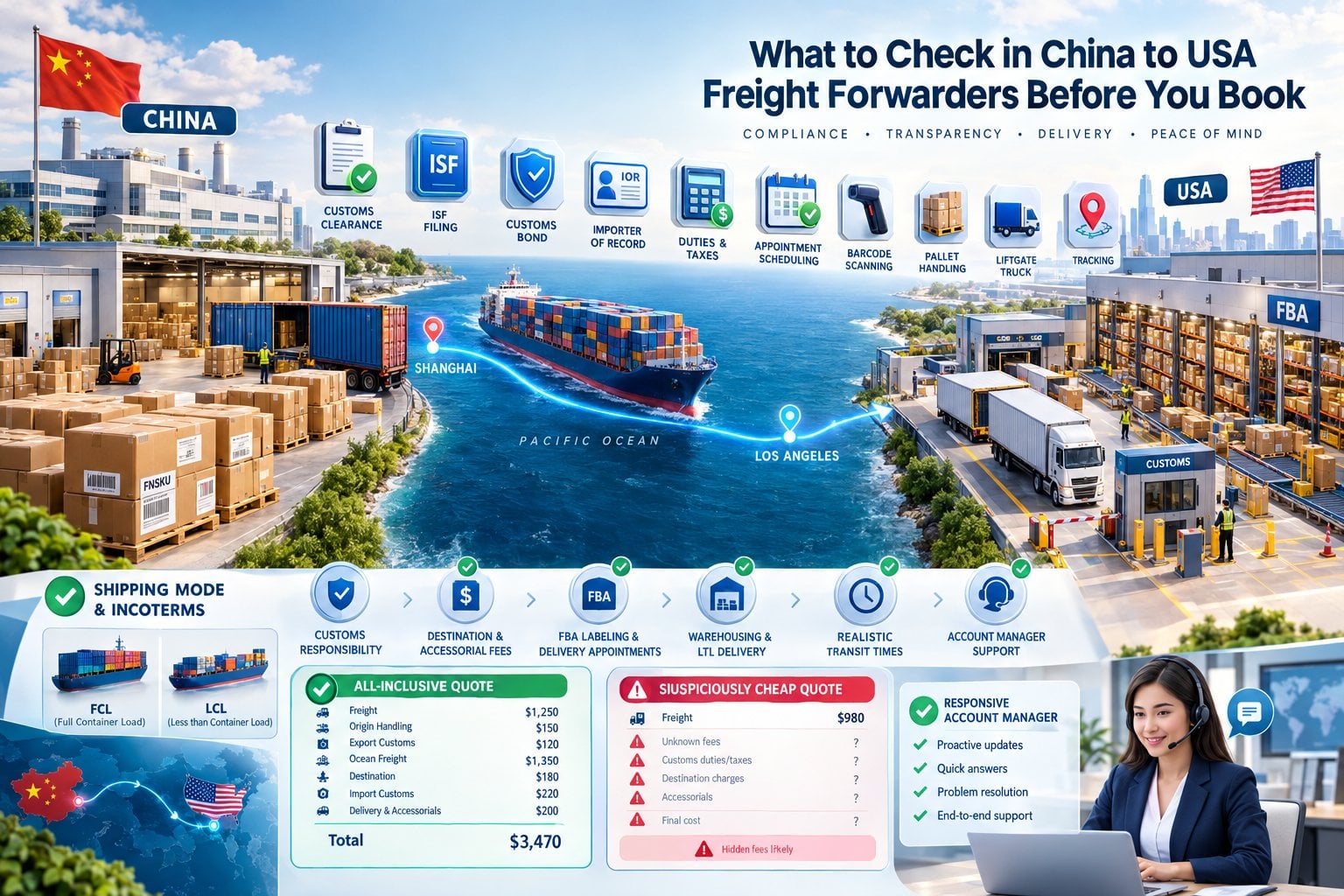
9 All-In Freight Quotes Vs. Itemized Accessorial Charges
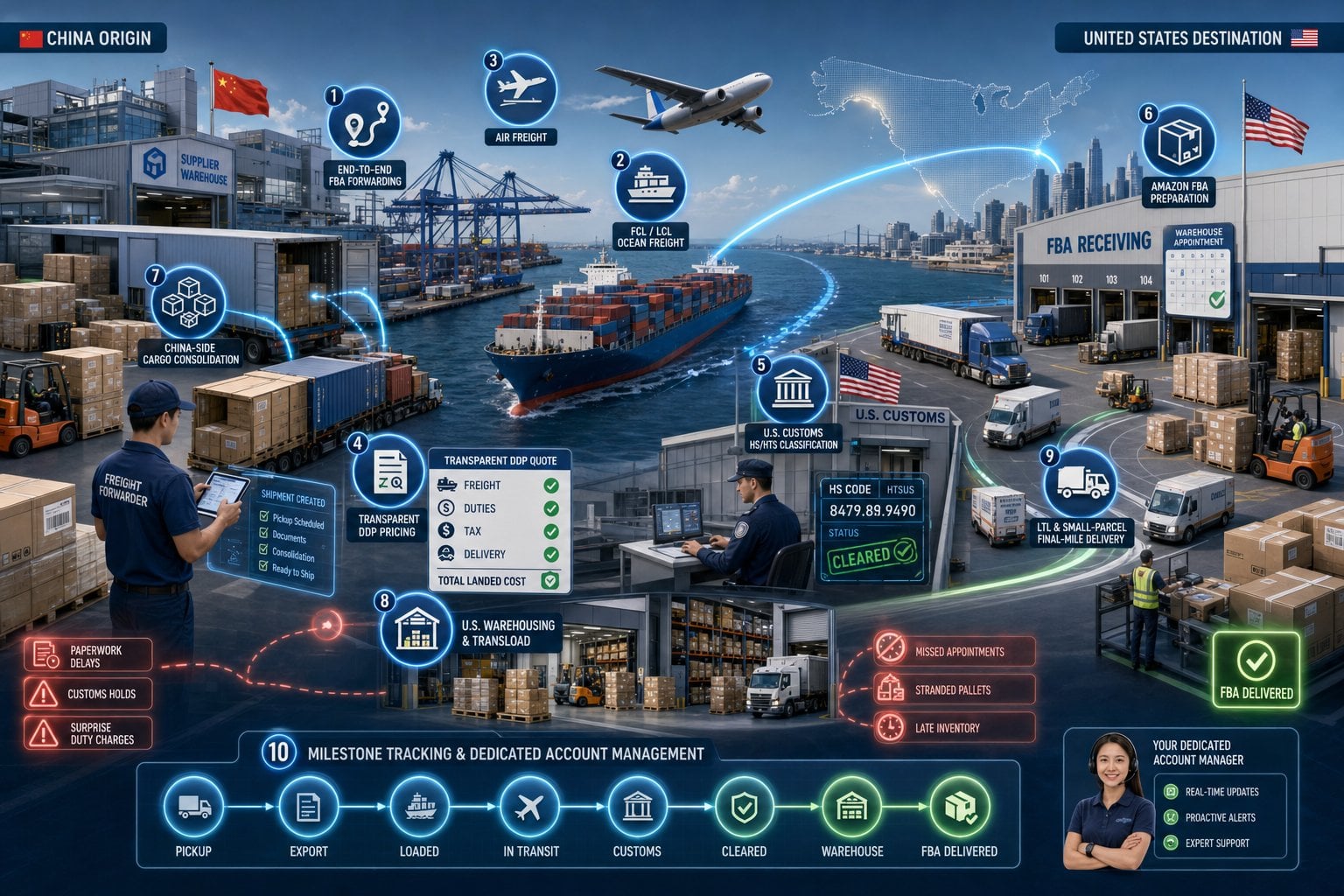
10 Shipment Tracking Milestones And Dedicated Account Management
11 How To Compare China-To-USA Forwarders Before Booking
11.1 Standardize Origin, Destination, Incoterms, Cargo Value, Weight, And Dimensions
11.2 Confirm The Importer Of Record And Duty-Payment Process In Writing
11.3 Verify Legal Registration, Relevant Network Credentials, And Escalation Contacts
11.4 Test Communication Quality With A Small Or Time-Sensitive Shipment
12.1 How do China-to-USA freight forwarders differ from US-based freight forwarders?
12.2 Which freight forwarder is best for shipping goods from China to the USA?
12.3 How much does it cost to ship freight from China to the USA?
12.4 What shipping methods do freight forwarders offer for China-to-USA shipments?
12.5 How do freight forwarders handle customs clearance for packages arriving from China?
12.6 How can I find the cheapest and most reliable freight forwarding option from China?
DDP Shipping Vs. FOB Shipping: Who Controls Duties And Import Risk
FOB (free on board) means your supplier’s job ends at the Chinese port. From there, you or your forwarder take over ocean freight, customs, duties, and delivery.
DDP (delivered duty paid) flips that around. The forwarder handles customs clearance, pays duties upfront, and delivers to your door for one price.
FOB gives you more control over which forwarder handles each leg, maybe saving money if you compare rates closely. DDP simplifies paperwork but usually costs more upfront since duty payment and risk are baked in.
Here’s the part sellers miss: under FOB, you’re the Importer of Record. You’re legally responsible for duties, even if your forwarder files the paperwork. Get this confirmed in writing before your cargo ships.
Some China to USA freight forwarding companies, like AEB Logistics, offer both models and will walk you through which fits your shipment value and risk tolerance. Compare total landed cost, not just the freight line, since DDP shipping costs more upfront but simplifies logistics with a single invoice.
RELATED Freight Forwarding Services: Comparing China–USA Providers
U.S. Customs Entry, Customs Bonds, And HTS Code Support
Customs clearance is where forwarders really start to separate themselves. Every ocean shipment needs an Importer Security Filing (ISF) submitted at least 24 hours before loading and a customs bond covering potential duties.
Some forwarders just offer a barebones filing service. Others provide HTS code classification help, duty estimation, and a choice between an annual bond or single-entry bond.
A wrong HTS code can trigger an audit or delay your cargo. If your forwarder won’t confirm your product’s classification before shipping, that’s a red flag.
Ask specifically:
Does the quote include customs brokerage, or is that billed separately?
Can they use their own bond, or do you need your own annual bond?
Who signs the Power of Attorney, and is that required before clearance?
AEB Logistics, for example, bundles customs brokerage into quotes for around $125 depending on commodity count and can sometimes offer use of its own bond. Compare that structure with any quote you’re looking at.
Amazon FBA Prep: FNSKU Labels, Carton Labels, And Delivery Appointments
Amazon FBA shipments come with extra requirements most general freight forwarders aren’t set up for. FNSKU labels identify individual units, carton labels go on shipping boxes, and Amazon requires delivery appointments booked through its Carrier Appointment Request Portal.
Miss any of these and Amazon can refuse the shipment at the dock. That’s not a fun surprise.
Some forwarders just move your cargo to a US warehouse and stop there, leaving you to book appointments and handle labeling. Others manage the entire FBA prep chain, including product inspection before labeling.
Ask your forwarder directly: do they apply FNSKU labels at origin, or only carton labels at a US warehouse? For LCL shipments, appointments usually get scheduled after your goods arrive at the forwarder’s US warehouse, not before.
This distinction matters most for first-time Alibaba importers who assume “FBA forwarding” always means full-service prep. It doesn’t. Confirm which labeling and appointment tasks are included before you compare price.
RELATED Freight Forwarder China To USA: Essential Guide For Efficient International Shipping
U.S. Warehousing: Receiving, Transload, Storage, And Inventory Splitting
Not every forwarder owns warehouse space. Some subcontract it, which adds a layer of communication delay when you need inventory pulled or split quickly.
Warehousing becomes important once your cargo lands. You’ll need receiving, transload (moving goods from container to truck or storage), and short-term storage before final delivery.
If you’re sending to multiple Amazon warehouses, inventory splitting is critical. Your forwarder needs to divide one shipment into several deliveries, each with its own labeling and appointment.
Third-party warehouse arrangements can actually help here. A local ship-from address lets you hold stock outside Amazon and replenish fulfillment centers on your own schedule.
Ask what happens if your cargo needs to sit in storage for two weeks before FBA slots open. Some forwarders charge daily storage fees that add up fast. Others build short-term storage into standard service. Get this answer in writing—storage costs are one of the easiest fees to underestimate on a quote.
RELATED Ultimate Guide: Finding the Best Freight Forwarder from China to the USA
FCL Containers Vs. LCL Consolidation For China-To-USA Ocean Freight
FCL means you book a whole container—20-foot, 40-foot, or 40-foot high-cube. LCL means your cargo shares space with other shipments and you pay by cubic meter.
Shipments under 15 cubic meters usually cost less via LCL. Larger volumes justify booking a full container.
FCL gives you exclusive use, tighter security, and often a lower per-unit cost at scale. LCL works for smaller or growing sellers who don’t need a full container’s worth of inventory yet.
The catch: LCL shipments take longer to clear since your cargo gets consolidated and deconsolidated at both ends. If your forwarder handles both FCL and LCL, ask how they consolidate cargo from multiple Alibaba suppliers into one shipment. That’s a common need for sellers ordering from several factories at once.
RELATED Freight forwarding from China to USA: How to Choose a China to USA Freight Forwarder?
Air Freight Vs. Express Courier For Urgent China-To-USA Shipments
Air freight and express courier both move faster than ocean, but they’re not the same thing.
Air freight ships as cargo through commercial or freight airlines, usually landing in about 7 to 10 days depending on the shipment and destination. Express courier, through DHL, FedEx, or UPS, moves door-to-door in as little as 2 to 4 days with customs clearance built in.
Air freight generally costs less per kilogram at higher volumes. Express courier costs more but works for smaller, urgent shipments—like a sample restock or a product recall fix—where speed trumps cost.
If you’re considering both, ask your forwarder for chargeable weight calculations upfront. Air freight bills by whichever is greater: actual weight or volumetric weight. A light, bulky product can cost more than its weight suggests.
RELATED China To USA Freight Forwarders: 11 Essential Checks
Alibaba Supplier Pickup And Multi-Supplier Cargo Consolidation
Sourcing from multiple Alibaba suppliers creates a coordination headache most first-time importers underestimate. Each factory ships on its own schedule, and someone needs to collect, inspect, and consolidate that cargo before it moves internationally.
Some forwarders only handle port-to-port transport, leaving factory pickup and consolidation to you or a sourcing agent. Others coordinate pickup directly from each supplier and consolidate everything into one shipment at a single warehouse.
This matters for cost and timing. Consolidating at origin, in China, is almost always cheaper than shipping separately and combining cargo in the US.
Ask your forwarder how they handle mismatched cargo-ready dates across suppliers. Do they wait for all suppliers before consolidating, or ship in batches? Get a clear answer—delays from one slow supplier shouldn’t hold up your entire shipment if batching is possible.
RELATED Top Tips to Find the Best Freight Forwarder China to USA
Amazon FBA Last Mile: LTL Freight, Small Parcel Delivery, And Liftgate Service
Last-mile delivery to Amazon fulfillment centers splits into two main methods: LTL (less-than-truckload) for palletized freight, and small parcel delivery (SPD) for individual boxes.
Your forwarder should tell you which method fits your shipment size since Amazon has different labeling and packaging rules for each.
Liftgate service matters if your pickup or delivery location doesn’t have a loading dock. Without one, a truck can’t unload pallets safely. This service typically adds a flat fee, often around $100, and residential deliveries can add further accessorial charges.
Before booking, confirm three things: which last-mile method applies to your shipment, whether liftgate service is included or billed separately, and whether your forwarder coordinates directly with carriers like Schneider, J.B. Hunt, or UPS Freight for this leg. Skipping this check is how sellers end up with surprise fees after delivery.
All-In Freight Quotes Vs. Itemized Accessorial Charges
A quote showing one flat number can hide a lot. Fuel surcharges, peak season fees, equipment positioning charges, and destination handling fees often sit outside the base rate.
Origin charges cover pickup, export customs, and terminal handling. Destination charges cover unloading, drayage, and container return. A base rate that looks cheap can balloon once these get added.
Ask for an itemized breakdown before you compare two quotes side by side. If a forwarder won’t break down charges, that says something about how they operate.
Some forwarders, AEB Logistics included, advertise itemized breakdowns on request so surcharges don’t surprise you after cargo has already shipped.
RELATED Freight Forwarding Services: Comparing China–USA Providers
Shipment Tracking Milestones And Dedicated Account Management
Once cargo leaves the factory, visibility becomes your main tool for planning inventory and customer expectations.
Basic forwarders send email updates only when something changes, which can mean silence for days. Better setups give you a tracking dashboard with milestones like Accepted, In Transit, Export Customs, Export Departure, Import Entry, Import Arrival, and Delivered.
A dedicated account manager matters more than most sellers expect until their first shipment hits a snag. Having one contact who already knows your shipment history saves time compared to explaining your situation to a new support agent every time you call.
Ask whether tracking updates automatically or whether you have to request them. Ask if you’ll have one point of contact for the life of the shipment. These small details can make or break your import experience, especially during peak season when phone lines and inboxes get backed up across the industry.
How To Compare China-To-USA Forwarders Before Booking
Comparing quotes side by side only works if you’re comparing the same shipment details. A cheaper number often means something got left out, not that you found a better deal.
Use this process before you commit to any forwarder, new or existing.
Standardize Origin, Destination, Incoterms, Cargo Value, Weight, And Dimensions
Send every forwarder the exact same shipment details: origin address, destination, Incoterm (FOB, EXW, or DDP), HS code, cargo value, box count, cubic meters, and kilograms.
Even small differences in these numbers can change quotes a lot. If you don’t standardize them, you really can’t compare pricing in any fair way.
Confirm The Importer Of Record And Duty-Payment Process In Writing
Ask directly who acts as the Importer of Record on your shipment. Make sure you know who pays duties, when, and how—especially for Amazon FBA shipments, since Amazon won’t act as Importer of Record and won’t accept cargo with unpaid duties or fees.
Verify Legal Registration, Relevant Network Credentials, And Escalation Contacts
Check that your forwarder is a legally registered logistics company. Look for credentials like membership in the Amazon Service Provider Network.
Ask who to contact if a shipment stalls at customs or if someone misses a delivery appointment. You don’t want to be left hanging if things go sideways.
Test Communication Quality With A Small Or Time-Sensitive Shipment
Before you commit to a full container or a recurring shipping schedule, test their response times and clarity with a smaller, time-sensitive shipment. How a forwarder handles a small urgent order tells you a lot about how they’ll handle a bigger one.
RELATED Freight Forwarder China To USA: Essential Guide For Efficient International Shipping
Frequently Asked Questions
How do China-to-USA freight forwarders differ from US-based freight forwarders?
China-focused forwarders usually have staff and relationships at Chinese factories and ports, which helps with pickup, export paperwork, and supplier coordination. US-based forwarders tend to focus on domestic distribution once the cargo lands.
For China-to-USA freight forwarding, origin-side coordination often matters just as much as the US delivery leg. It’s not always obvious, but it makes a difference.
Which freight forwarder is best for shipping goods from China to the USA?
There’s no single best option. It depends on your shipment size, product type, and whether you need Amazon FBA prep or just general warehousing and fulfillment.
Compare providers on customs support, DDP shipping availability, and communication style—not just price. A forwarder that’s great for full container loads might be a terrible fit for a small parcel Amazon seller.
How much does it cost to ship freight from China to the USA?
Costs really depend on mode and volume. Ocean freight for a 20-foot container has recently run in the $5,400 to $6,600 range.
LCL has priced around $130 per cubic meter. Air freight and express courier cost more per kilogram but move faster, so your total cost comes down to urgency and cargo volume.
What shipping methods do freight forwarders offer for China-to-USA shipments?
Most forwarders offer ocean freight (FCL and LCL), air freight, and express courier. DDP options bundle customs and delivery into one price.
Amazon FBA sellers can usually add labeling, warehousing, and last-mile delivery to any of these modes. It really depends on what you need.
How do freight forwarders handle customs clearance for packages arriving from China?
Forwarders either use their own licensed customs brokers or partner with brokerage firms to file entry documents, calculate duties, and submit the required Importer Security Filing.
Strong customs support includes help with HTS code classification and duty estimation before your shipment even leaves China. If you don’t get this up front, you could be in for a headache later.
How can I find the cheapest and most reliable freight forwarding option from China?
Start by asking several forwarders for itemized quotes using the exact same shipment details. Don’t just look at the base freight rate—compare the total landed cost.
Watch out for extra fees like customs brokerage, warehousing, or liftgate service. Sometimes the cheapest-looking option actually costs more once you add everything up.