How to Compare Forwarder Websites Before Quotes for U.S. Imports
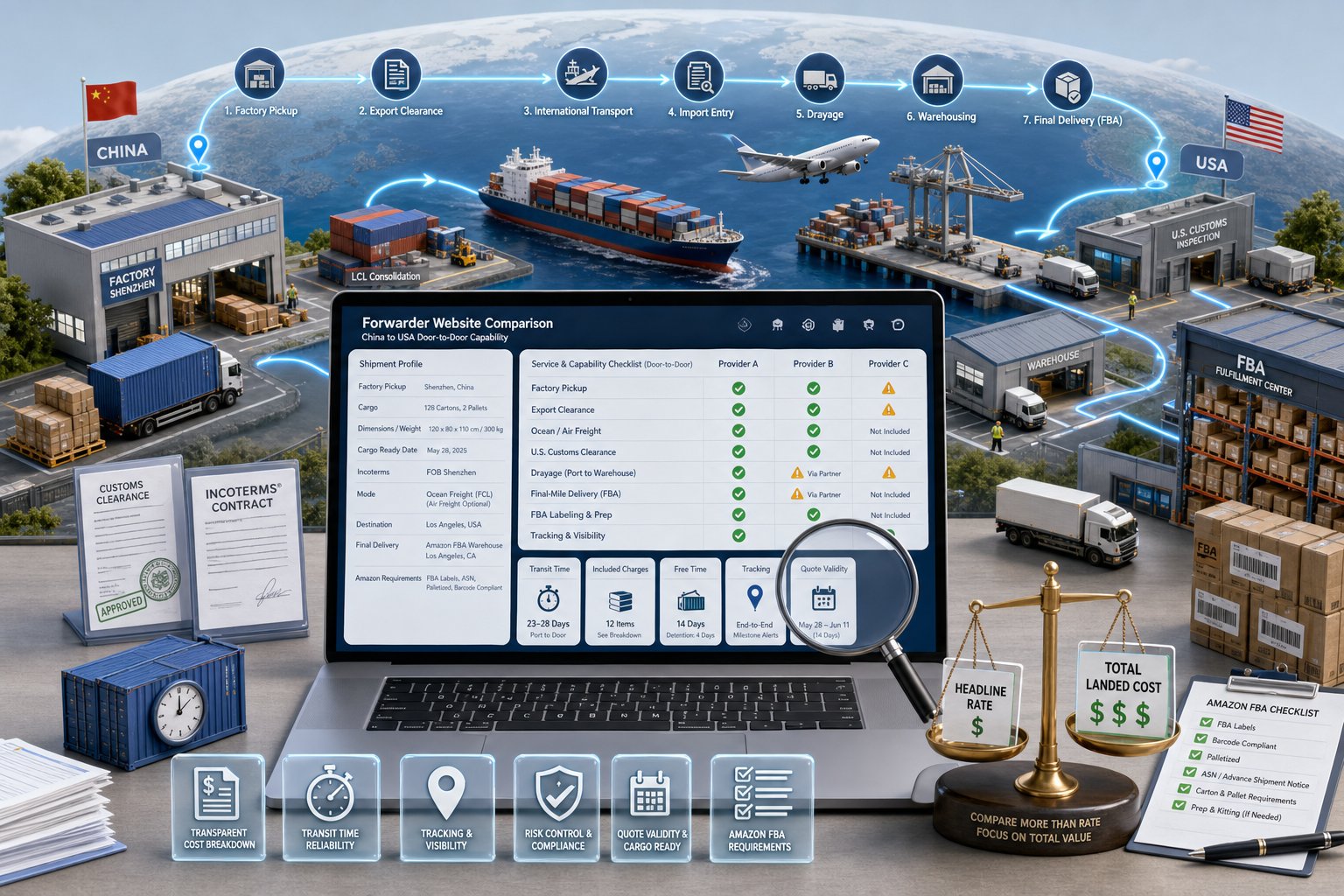
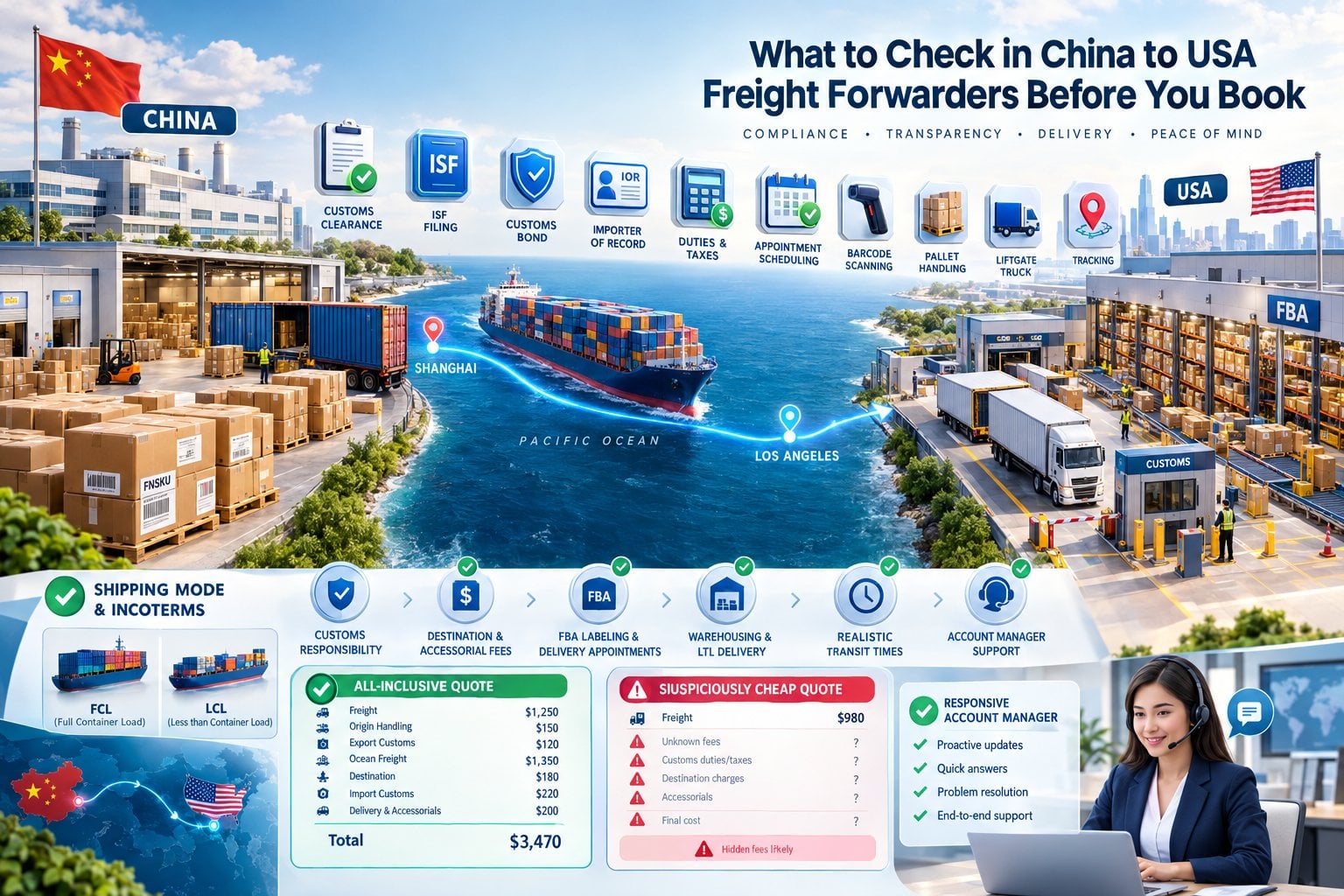
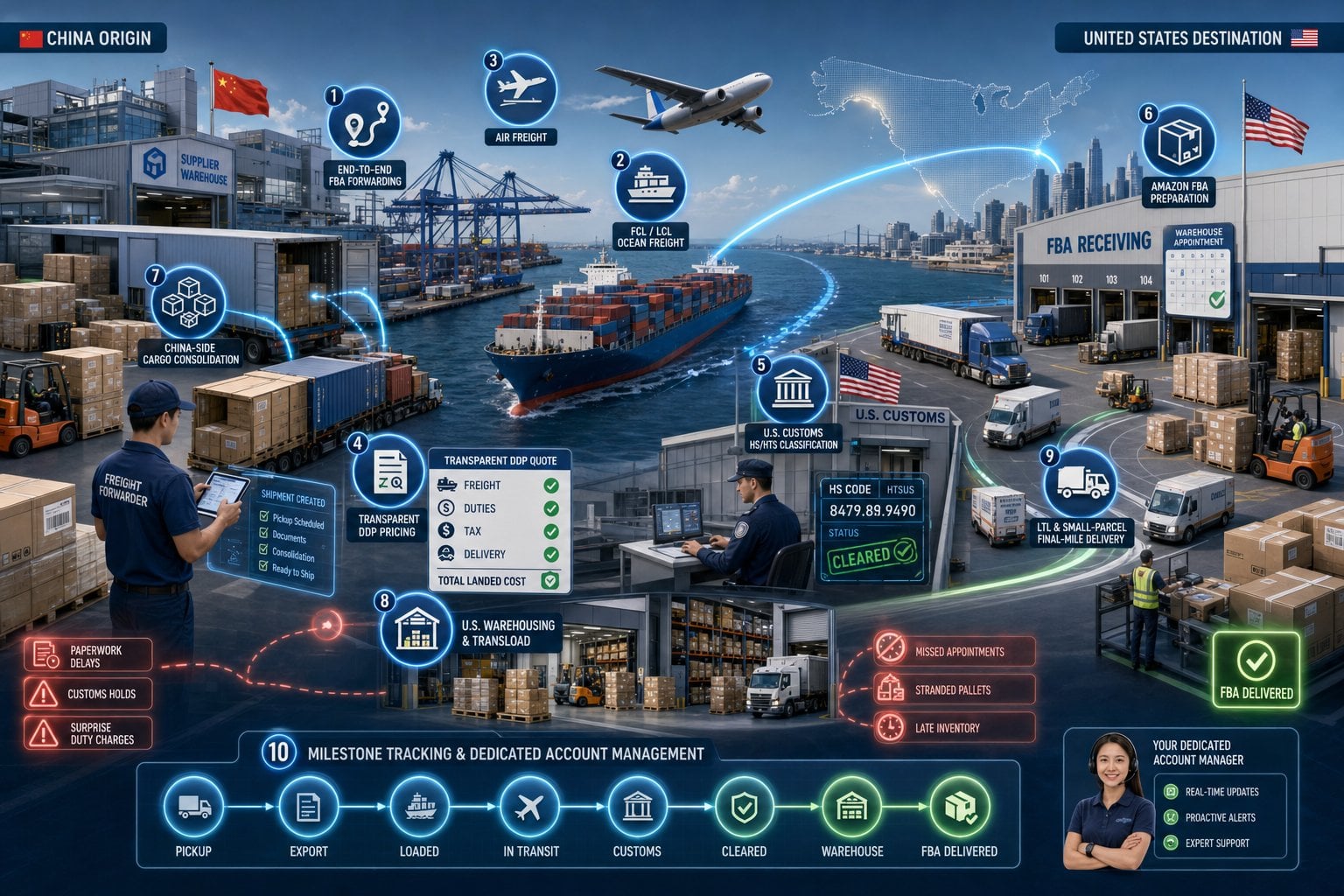
A forwarder’s website tells you more than its rate card. Before you request a single quote, the site itself should show you whether the company can pick up from your factory, clear U.S. customs, and deliver to an Amazon fulfillment center without handing your shipment off to three different subcontractors.
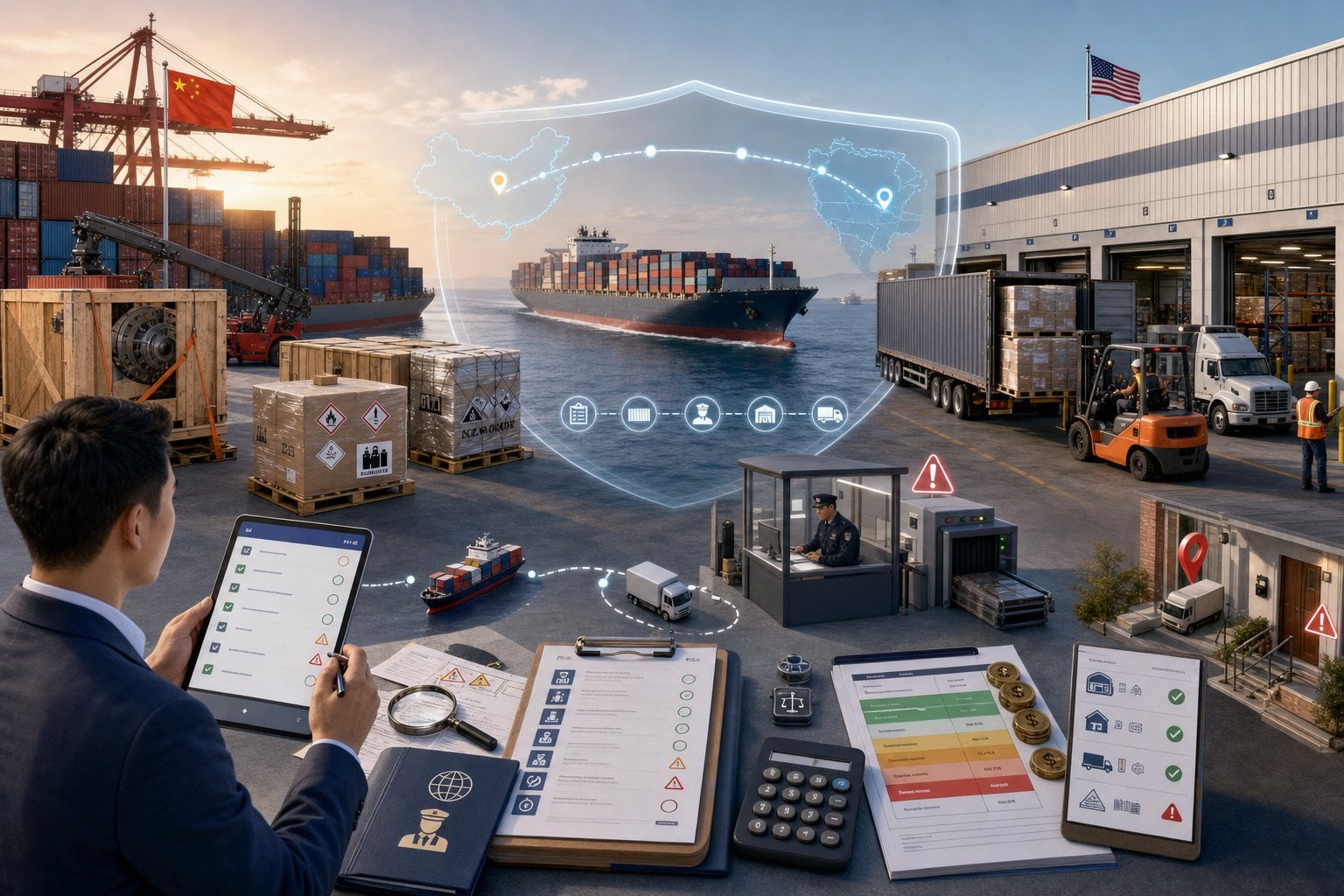
Most importers skip this step. They collect three or four rate quotes, pick the cheapest, and find out later that “door-to-door” meant “port-to-door” or that FBA labeling wasn’t included. Comparing forwarder websites before quotes means checking for route-specific proof, not just a price range — proof of your exact lane, your cargo type, and your delivery requirements.
This matters more for China-to-USA freight forwarding than most trade lanes, because the handoffs are numerous: factory pickup, export clearance, ocean or air transport, U.S. import entry, drayage, and often a final leg to an Amazon warehouse. A site that only shows a rate calculator skips over all of that.
Ready to skip the shipping headaches? Get an all-inclusive, door-to-door quote from AEB Logistics who keeps you updated at every single stage. Visit aeblogistics.com or email us directly at support@aeblogistics.com — let's build a worry-free supply chain together.
Contents hide
2 Start With One Complete Shipment Profile
2.1 Which Cargo Details Should You Prepare Before Visiting Forwarder Sites?
2.2 How Do Incoterms Change the Service You Need?
2.3 When Do Cargo Type and Special Handling Change the Search?
3 What Should a Forwarder Website Prove?
3.1 Can the Forwarder Handle Your Exact China-to-USA Lane?
3.2 Does the Site Explain Its Role and Carrier Network?
3.3 Are Service Scope and Exclusions Clearly Stated?
4 Evaluate Transport, Delivery, and Destination Coverage
4.1 Which Mode Fits Your Shipment: Air Freight, LCL, or FCL?
4.2 Does Door-to-Door Delivery Include the U.S. Final Mile?
4.3 What Should the Website Say About Transit Time and Tracking?
5 Review FBA, Customs, and Warehouse Readiness
5.1 Can the Forwarder Support Amazon FBA Delivery Requirements?
5.2 How Should Customs Clearance and Importer Responsibilities Be Explained?
5.3 When Are Warehousing, Transload, and Shipment Splitting Necessary?
6 Check Transparency, Risk Controls, and Support
6.1 Which Charges Should Be Visible Before You Ask for a Quote?
6.2 How Do Free Time, Demurrage, and Detention Affect Risk?
6.3 What Evidence Supports Credibility and Responsive Service?
7 Turn Website Research Into Comparable Quote Requests
7.1 How Do You Request Like-for-Like Freight Forwarder Quotes?
7.2 How Should You Compare Total Landed Cost Instead of the Headline Rate?
7.3 Should You Use Freightos, All Forward, or Direct Forwarder Quotes?
8.1 How can I compare freight forwarder websites before requesting quotes?
8.2 What should a China-to-USA freight forwarder website clearly show?
8.3 How do I know whether a forwarder can handle Amazon FBA deliveries?
8.4 What is a good freight quote for international shipping from China?
8.5 How long is a freight quote usually valid?
8.6 Should I choose DDP shipping or arrange customs clearance myself?
RELATED Freight Forwarder Comparison for China to USA Imports: 2026 Guide
Key Takeaways
Build a complete shipment profile (cargo type, Incoterm, dimensions, cargo-ready date) before you visit any forwarder site, so you can judge fit instead of guessing.
Check that a forwarder’s website explains its role, carrier network, service scope, and FBA capabilities before you request a quote.
Compare total landed cost and free-time terms across forwarders, not just the headline freight rate.
RELATED Freight Forwarding Services: Comparing China–USA Providers
Start With One Complete Shipment Profile
A forwarder’s website only becomes useful once you know exactly what you’re shipping. Without a defined cargo type, Incoterm, and cargo-ready date, you’ll misread every service page you visit, because most forwarder sites assume you already know your shipment profile. Building that profile first turns a vague website visit into a targeted evaluation.
Which Cargo Details Should You Prepare Before Visiting Forwarder Sites?
Write down your cargo type, box count, cubic meters, weight in kilograms, and HS code before you start comparing sites. These details determine which service pages even apply to you, and they’re the same details AEB Logistics asks for when preparing a shipping quote: origin and destination, cargo value, box count, cubic meters, kilograms, and an estimated cargo-ready date.
Also gather your commercial invoice and packing list format, or at least know what fields they’ll include. Customs brokers and carriers use these documents to prepare your customs declaration, and a forwarder’s website should tell you which documents they need from you versus which ones they prepare on your behalf.
How Do Incoterms Change the Service You Need?
Your Incoterm decides who arranges the ocean or air transport, who pays duties, and where liability shifts. FOB (Free on Board) means the supplier delivers to the origin port and you (or your forwarder) arrange everything past that point. EXW (Ex Works) means your forwarder must also arrange factory pickup in China.
CIF (Cost, Insurance, Freight) shipments arrive with freight and insurance already paid by the seller, which limits your ability to negotiate the ocean leg. DDP (Delivered Duty Paid) shifts duty and tax payment to the seller or forwarder, which changes what you should expect the U.S. side of a quote to include. Confirm which Incoterm your supplier is quoting before you compare forwarder websites, since a site built around FOB pickup won’t necessarily explain EXW factory-collection steps clearly.
When Do Cargo Type and Special Handling Change the Search?
Standard cartons, palletized cargo, and DG (dangerous goods) all need different website proof points. If your cargo includes batteries, aerosols, or other regulated goods, look for a forwarder site that explicitly addresses DG declaration and handling, not just general cargo language.
Oversized or heavy cargo may push you toward FCL (Full Container Load) regardless of volume, since handling constraints can matter more than cubic meters. Note any special handling needs now, so you can filter out sites that don’t mention them at all.
RELATED China to USA Freight Forwarders: 9 Quote Checks Before You Ship
What Should a Forwarder Website Prove?
A forwarder’s website should prove three things before you request a quote: that they operate your specific China-to-USA lane, that they explain their role and carrier relationships, and that they state clearly what is and isn’t included in their service. Rate calculators and generic “we ship worldwide” language don’t answer any of these.
Can the Forwarder Handle Your Exact China-to-USA Lane?
Look for named origin ports or cities in China and named U.S. destinations, not just a world map graphic. A freight forwarder that regularly moves cargo from Shenzhen or Shanghai to U.S. ports will usually say so directly, the way AEB Logistics details its work in Shenzhen and Shanghai as origin points for China-to-USA freight forwarding.
Lane specificity matters because carrier space, consolidation schedules, and customs familiarity all vary by port pair. A freight forwarder selection checklist should include confirming your forwarder’s actual reach into your origin and destination markets, not just a general service claim.
Does the Site Explain Its Role and Carrier Network?
A transparent website distinguishes between the freight forwarder’s own coordination role and the underlying carrier or NVOCC (Non-Vessel Operating Common Carrier) moving the cargo. Some forwarders operate as licensed NVOCCs regulated by the FMC (Federal Maritime Commission); others book space through partner NVOCCs and carriers.
Neither structure is better on its own, but the site should say which one applies and name at least some carrier relationships. AEB Logistics, for example, lists carrier relationships including Schneider, J.B. Hunt, YRC, Landstar, North American, UPS Freight, and FedEx Freight for its U.S. trucking coordination. A freight forwarder comparison checklist recommends confirming a forwarder’s agent and partner network strength at both origin and destination before moving forward.
Are Service Scope and Exclusions Clearly Stated?
Scope clarity separates a useful website from a marketing page. Look for explicit statements about what’s included in a standard quote (customs coordination, documentation, delivery) and what typically costs extra (liftgate service, residential delivery, storage beyond a free period).
A site that only advertises “freight forwarder quotes” without describing service boundaries will likely produce quotes you can’t compare later. Reviewing multiple international freight forwarding companies side by side works best when each one publishes its scope details up front, rather than making you ask for them one at a time.
RELATED China To USA Freight Forwarders: 11 Essential Checks
Evaluate Transport, Delivery, and Destination Coverage
The right transport mode depends on your cargo’s size, urgency, and budget, and a good forwarder website will help you match those factors instead of pushing one mode by default. Air freight, LCL (Less than Container Load), and FCL each fit different shipment profiles, and door-to-door delivery claims need to specify exactly where “door” ends.
Which Mode Fits Your Shipment: Air Freight, LCL, or FCL?
Air freight suits urgent or high-value cargo that doesn’t fill a container. AEB Logistics notes that an air shipment from Hong Kong to Los Angeles can take around five days, while ocean freight for the same route can take at least three weeks; general FBA guidance estimates air freight at roughly 7 to 10 days depending on the shipment and destination.
LCL works when your cargo doesn’t need a full container, letting you pay only for the space you use inside a shared container. FCL becomes cost-effective at higher volumes or when cargo needs dedicated container security; AEB Logistics offers 20-foot, 40-foot, and 40-foot high-cube container options for FCL shipments. Once cargo lands, LTL (Less than Truckload) trucking typically handles the final domestic delivery leg for LCL and smaller FCL shipments.
Does Door-to-Door Delivery Include the U.S. Final Mile?
“Door-to-door” should mean delivery to your actual U.S. address or Amazon fulfillment center, not just to a port or a regional hub. Confirm whether the quoted price includes container drayage, final-mile LTL delivery, and any liftgate service for locations without a loading dock; AEB Logistics states liftgate service carries an additional fee of USD 100 when needed.
Residential deliveries and pickups often carry added accessorial fees, so ask the forwarder to itemize these before you compare against another quote. A freight forwarder evaluation checklist recommends confirming exactly where the forwarder’s responsibility ends, since mismatched delivery scope is one of the most common causes of quote confusion.
What Should the Website Say About Transit Time and Tracking?
Published transit times should be specific to mode and lane, not a single vague estimate. AEB Logistics publishes general China-to-USA estimates of about 3 to 5 days for express courier, 8 to 10 days for standard air freight, and roughly 30 to 40 days for door-to-door ocean freight, while noting that customs processing, port congestion, and carrier schedules can shift these figures.
The site should also explain how you’ll track your shipment once it moves, including whether you get milestone updates like export departure, import arrival, and delivery confirmation. AEB Logistics shares shipment status through stages such as Accepted, In Transit, Export Customs, Export Departure, Import Entry, Import Arrival, and Delivered, detailed further on its shipment tracking page.
Review FBA, Customs, and Warehouse Readiness
Amazon FBA shipments add requirements that generic freight forwarder websites often gloss over, including labeling, delivery appointments, and strict rules about unpaid charges. Before requesting quotes, confirm the site addresses FBA prep, explains who’s responsible for customs duties, and describes warehousing options for cargo that can’t go straight to Amazon.
Can the Forwarder Support Amazon FBA Delivery Requirements?
Look for specific FBA capabilities: FBA labeling, carton and pallet prep, and delivery appointment scheduling through Amazon’s Carrier Appointment Request Portal. AEB Logistics, a member of the Amazon Service Provider Network, supports factory pickup through delivery to Amazon FBA, FBA and UPS labeling, inventory management, and shipment splitting across multiple Amazon warehouses, detailed on its Amazon FBA forwarding page.
For LCL shipments, Amazon delivery appointments are typically scheduled after goods arrive at the forwarder’s destination warehouse. If you’re using your own carrier, the forwarder will need your bill of lading, Amazon FBA booking form, and carrier manual to help coordinate the appointment, a detail covered in AEB Logistics’ FBA fulfillment guidance.
How Should Customs Clearance and Importer Responsibilities Be Explained?
Importers remain responsible for duties and taxes regardless of who files the paperwork, and a trustworthy website says this plainly. Amazon does not act as Importer of Record for FBA shipments and will refuse cargo arriving with unpaid duties, taxes, or shipping charges.
Look for mentions of customs bond options, HS/HTS code guidance, and whether a Power of Attorney is required for the forwarder to file your entry. AEB Logistics states that customs brokerage can be included in a shipment quote and usually costs around USD 125, depending on the number of commodities, with details on its customs clearance checks page. If you’re weighing DDP shipping against handling clearance yourself, the site should explain both paths rather than defaulting to one.
When Are Warehousing, Transload, and Shipment Splitting Necessary?
Warehousing becomes necessary when cargo needs to be split across multiple Amazon warehouses, prepped further, or held while you manage inventory flow. Look for storage space, pick-and-pack services, palletization, and transload capability described on the site, not just mentioned in passing.
Third-party warehouse arrangements can also give you a stable U.S. ship-from address for replenishing FBA inventory over time. AEB Logistics outlines these services, including shipment splitting for FBA delivery, on its warehousing page.
RELATED Top Qualities of Leading Forwarders
Check Transparency, Risk Controls, and Support
A transparent forwarder website itemizes charges before you ask, explains free time and demurrage exposure, and shows evidence of responsive account management. These three checks catch most of the hidden costs that turn a cheap-looking quote into an expensive shipment.
Which Charges Should Be Visible Before You Ask for a Quote?
Origin charges, destination charges, and documentation fees should all be named on the site, even if exact amounts require a quote request. Red flags include vague phrasing like “freight as quoted” instead of itemized line items, and any quote with no valid-until date, according to a guide on getting accurate freight quotes.
Ask specifically whether surcharges like fuel adjustments or CAF (Currency Adjustment Factor) are included in the base freight rate or added afterward. A site that already answers this in its FAQ or service pages saves you a round of emails later, and reflects the “no sneaky surcharges” standard AEB Logistics states as part of its quote approach.
How Do Free Time, Demurrage, and Detention Affect Risk?
Free time is the number of days you can use a container or terminal space before extra charges start; demurrage applies when cargo sits at the port past that window, and detention applies when the container itself sits outside the port past its free days. These charges can accumulate quickly during customs delays or port congestion, so ask upfront how many free days are included and what the daily rate becomes afterward.
A forwarder’s website should mention these terms directly, since evaluating a freight forwarder for reliability depends partly on how clearly they explain exception costs before they happen, not after. Cargo insurance is a separate consideration worth confirming too: ask whether it’s included, optional, or arranged separately, since standard carrier liability rarely covers full replacement value.
What Evidence Supports Credibility and Responsive Service?
Look for a named point of contact, published business registration details, and a working support channel, since these signal accountability if something goes wrong mid-shipment. AEB Logistics publishes its Chinese legal entity name, 青岛安柏物流有限公司, and Unified Social Credit Code, verifiable through China’s National Enterprise Credit Information Publicity System.
A dedicated account manager model, where one person handles your shipment from quote to delivery, tends to produce faster answers during exceptions than a rotating support queue. Test responsiveness before you commit by sending a real question to the support email listed on the site and timing the reply.
RELATED China-USA Freight Forwarding: 8 Questions to Ask Before Choosing a Provider
Turn Website Research Into Comparable Quote Requests
Website research only pays off once it turns into quote requests that are genuinely comparable across forwarders. That means submitting the same shipment profile to each forwarder, judging total landed cost instead of the headline freight rate, and knowing when a quote marketplace versus a direct forwarder relationship fits your shipment better.
How Do You Request Like-for-Like Freight Forwarder Quotes?
Send every forwarder the same shipment details: origin, destination, Incoterm, HS code, cargo value, box count, cubic meters, weight, and cargo-ready date. This is the exact information AEB Logistics requests for its free shipping quote, and matching this format across forwarders removes the guesswork from comparing their responses.
Ask each forwarder to confirm the quote’s valid-until date, since ocean rates can expire in 48 to 72 hours, according to guidance on requesting accurate freight quotes. Request an itemized breakdown rather than a single all-in number, so you can see where forwarders differ on origin charges, destination charges, and documentation fees.
How Should You Compare Total Landed Cost Instead of the Headline Rate?
Total landed cost adds freight, customs clearance, duties, drayage, warehousing, and final delivery into one number, and it’s the only fair way to compare forwarders. A freight quote comparison guide recommends always requesting all-in door-to-door pricing, covering origin inland haulage, export customs, origin terminal handling, main carriage surcharges, destination terminal handling, import customs and duty filing, and destination inland delivery.
| Comparison Point | Headline Rate Only | Total Landed Cost |
|---|---|---|
| Includes duties and taxes | No | Yes |
| Includes destination delivery | Often unclear | Confirmed itemized |
| Includes customs brokerage | Rarely | Yes, when itemized |
| Reveals demurrage/detention risk | No | Discussed upfront |
| Comparable across forwarders | Misleading | Accurate |
A quote that looks cheaper on the headline rate can end up costing more once destination charges, storage, and duty filing fees appear on the final invoice. A CargoLinked comparison guide points out that a quote significantly lower than all others is usually missing key charges rather than offering a genuine discount.
Should You Use Freightos, All Forward, or Direct Forwarder Quotes?
Freight quote marketplaces like Freightos and All Forward let you request quotes from multiple forwarders at once, using a standardized form that simplifies early comparison. This approach works well for a first pass at market rates or when you’re shipping an unfamiliar lane for the first time.
Direct forwarder relationships tend to work better once your shipments become recurring, since a dedicated account manager can flag exceptions, coordinate FBA appointments, and manage documentation for your specific product line over time. Many importers use both: a marketplace for initial rate benchmarking, then a direct forwarder relationship for ongoing China-to-USA freight forwarding once volume and requirements stabilize.
RELATED China to USA Freight Forwarders: 2026 Comparison, Costs, and Best Services
Frequently Asked Questions
How can I compare freight forwarder websites before requesting quotes?
Build your shipment profile first (cargo type, Incoterm, weight, and cargo-ready date), then check each forwarder’s site for lane-specific proof, clear service scope, and named carrier relationships. Confirm the site explains customs responsibility and FBA capabilities if you’re shipping to Amazon. Sites that itemize charges upfront are easier to compare later.
What should a China-to-USA freight forwarder website clearly show?
The site should name specific origin ports in China and U.S. destinations, describe its role versus its carrier network, and state what’s included in door-to-door pricing. It should also explain customs brokerage costs, bond options, and typical transit times for air and ocean freight. Vague “we ship anywhere” language without these details is a warning sign.
How do I know whether a forwarder can handle Amazon FBA deliveries?
Look for explicit mention of FBA labeling, delivery appointment scheduling through Amazon’s Carrier Appointment Request Portal, and shipment splitting across multiple fulfillment centers. Confirm whether the forwarder is a member of Amazon’s Service Provider Network, which signals familiarity with FBA-specific requirements. Ask how they handle LCL shipments that need appointments scheduled after arrival at their warehouse.
What is a good freight quote for international shipping from China?
A good quote itemizes freight, customs clearance, and destination delivery separately, rather than bundling everything into one number. Customs brokerage alone often runs around USD 125 depending on the number of commodities, so a quote that doesn’t break this out is harder to trust. Compare total landed cost across forwarders, not just the headline freight rate.
How long is a freight quote usually valid?
Ocean freight quotes can expire in as little as 48 to 72 hours because of shifting carrier rates and space availability. Air freight quotes may hold slightly longer but still fluctuate with fuel surcharges and capacity. Always confirm the valid-until date before you use a quote to make a shipping decision.
Should I choose DDP shipping or arrange customs clearance myself?
DDP (Delivered Duty Paid) shipping shifts duty and tax payment to your forwarder or supplier, which simplifies your side of the transaction but usually costs more upfront. Arranging customs clearance yourself gives you more visibility into duty calculations but requires more coordination and documentation on your part. Importers new to China-to-USA freight forwarding often start with DDP, then move to self-managed clearance once shipment volume justifies the extra coordination.