Door-to-Door Shipping from China to USA Costs Explained
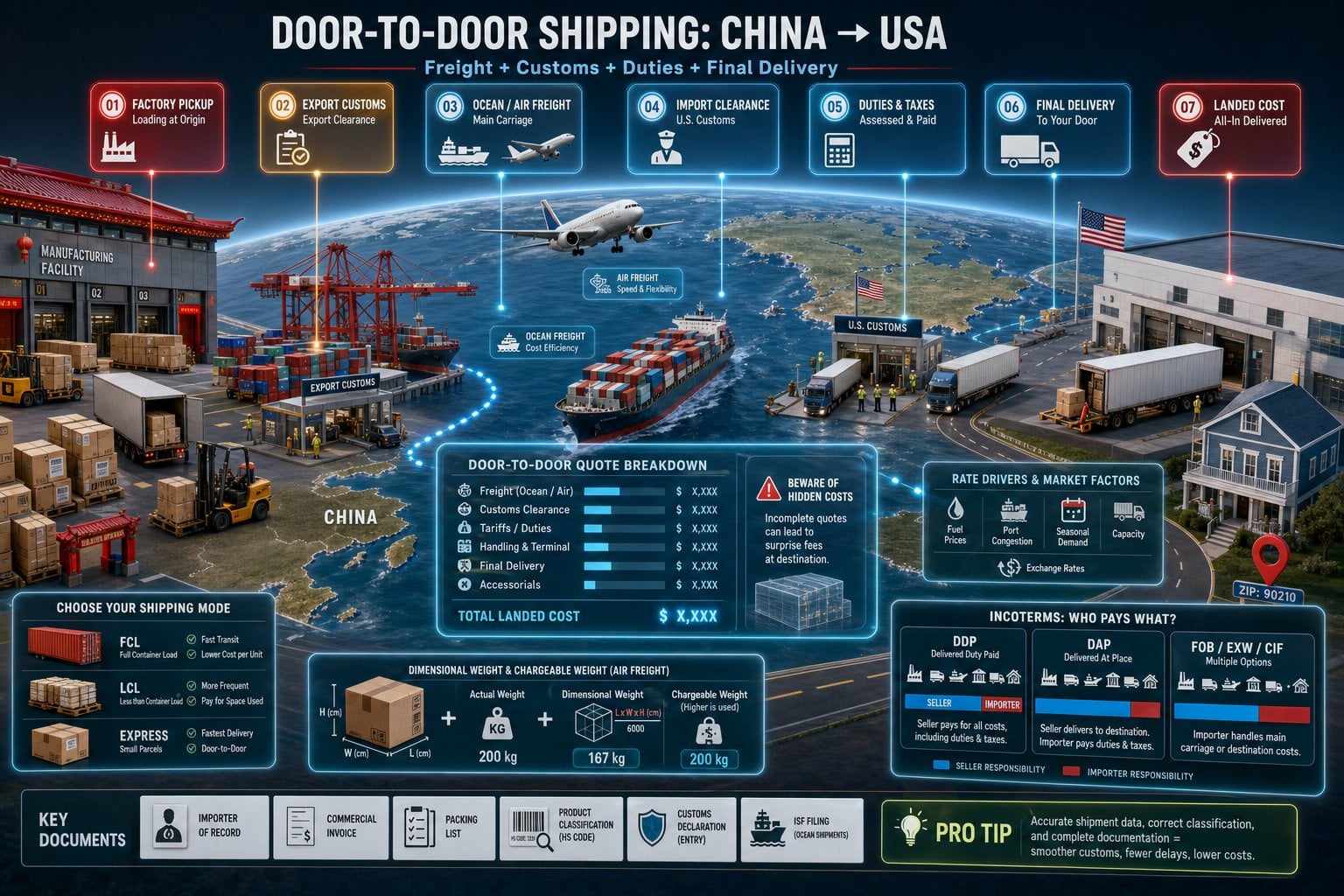
When calculating door to door shipping from China to USA costs, the number on a quote sheet rarely tells the whole story. A real door-to-door quote should account for factory pickup, export customs, ocean or air transport, import clearance, duties, and final delivery to your address, not just the freight line item. Getting that scope right up front separates a workable budget from surprise arrival fees.
Commercial cargo shipping from China involves more moving parts than a single freight rate suggests. A freight forwarder handling international freight for you is coordinating customs brokers, truckers, ocean or air carriers, and destination warehouses, often across two countries and two regulatory systems. Knowing what’s baked into a quote, and what isn’t, protects your margins before goods ever leave the factory.
This matters more for repeat importers than first-timers realize. Once your supply chain scales past a handful of shipments a year, small gaps in a quote (an excluded accessorial, an unclear Incoterm, a missing duty estimate) compound fast.
Ready to skip the shipping headaches? Get an all-inclusive, door-to-door quote from AEB Logistics who keeps you updated at every single stage. Visit aeblogistics.com or email us directly at support@aeblogistics.com — let's build a worry-free supply chain together.
Contents hide
2 What Does a Door-to-Door Quote Cover?
2.1 From Factory Pickup to Final Delivery
2.2 Door-to-Door Shipping vs. Port-to-Port Service
2.3 Costs That May Be Included or Excluded
3 How Much Do Air, Ocean, and Express Options Cost?
3.1 Air Freight Rates and Chargeable Weight
3.2 Ocean Freight Costs for FCL and LCL Cargo
3.3 Express Courier Pricing for Small Parcels
3.4 How to Use Rate Ranges Without Mistaking Them for Fixed Quotes
4 Which Freight Method Offers the Best Value for Your Cargo?
4.1 When Air Freight Is Worth the Higher Cost
4.2 When LCL Consolidation Is the Better Choice
4.3 When a Full Container Load Lowers Cost per Unit
4.4 When Express Shipping Makes Sense
5 What Drives Your Final Landed Cost?
5.1 Cargo Dimensions, Weight, and Packaging
5.2 Route, Destination ZIP Code, and Inland Delivery Conditions
5.3 Duties, Taxes, and Tariff Exposure
5.4 Seasonal Demand, Fuel, and Port Disruption Costs
6 How Do DDP, DAP, and Other Incoterms Change the Price?
6.1 Delivered Duty Paid: What a DDP Quote Should State
6.2 Delivered at Place: Which Charges the Importer Pays
6.3 FOB, EXW, and CIF: Where Cost Responsibility Begins
6.4 Why the Importer of Record Must Be Clear
7 Which Documents and Customs Steps Can Affect Delivery Costs?
7.1 Commercial Invoice, Packing List, and Product Classification
7.2 ISF Filing Requirements for Ocean Imports
7.3 Customs Clearance, Bonds, and Duty Payment
7.4 How Accurate Shipment Data Prevents Delays and Extra Charges
8.1 How much does door-to-door shipping from China to the USA cost per kg?
8.2 What is the cheapest way to ship commercial cargo from China to the USA?
8.3 How much does it cost to ship a 40-foot container from China to the USA?
8.4 Do I pay tariffs and import duties when shipping from China to the USA?
8.5 How long does door-to-door shipping from China to the USA take?
8.6 Is DHL, FedEx, or UPS cheaper than air freight for small shipments?
RELATED Door-to-Door Shipping Rates China to USA: Costs, Methods, and Key Considerations
Key Takeaways
Door-to-door pricing depends on cargo weight, volume, mode of transport, and destination address, not a single flat rate.
Air, ocean FCL, ocean LCL, and express each hit a different price-per-unit sweet spot depending on shipment size and urgency.
Your final landed cost includes duties, tariffs, fees like the Merchandise Processing Fee, and delivery accessorials on top of the base freight quote.
RELATED Door-to-Door Shipping Quotes China to USA: Complete Guide & Cost Factors
What Does a Door-to-Door Quote Cover?
A complete door-to-door quote should cover pickup at the factory, export customs clearance, international transport, import customs clearance, inland trucking, and last-mile delivery to your final address. Each of those steps carries its own cost and its own point of possible delay, so a forwarder quoting door-to-door shipping from China to the USA needs to account for all of them, not just the ocean or air leg.
From Factory Pickup to Final Delivery
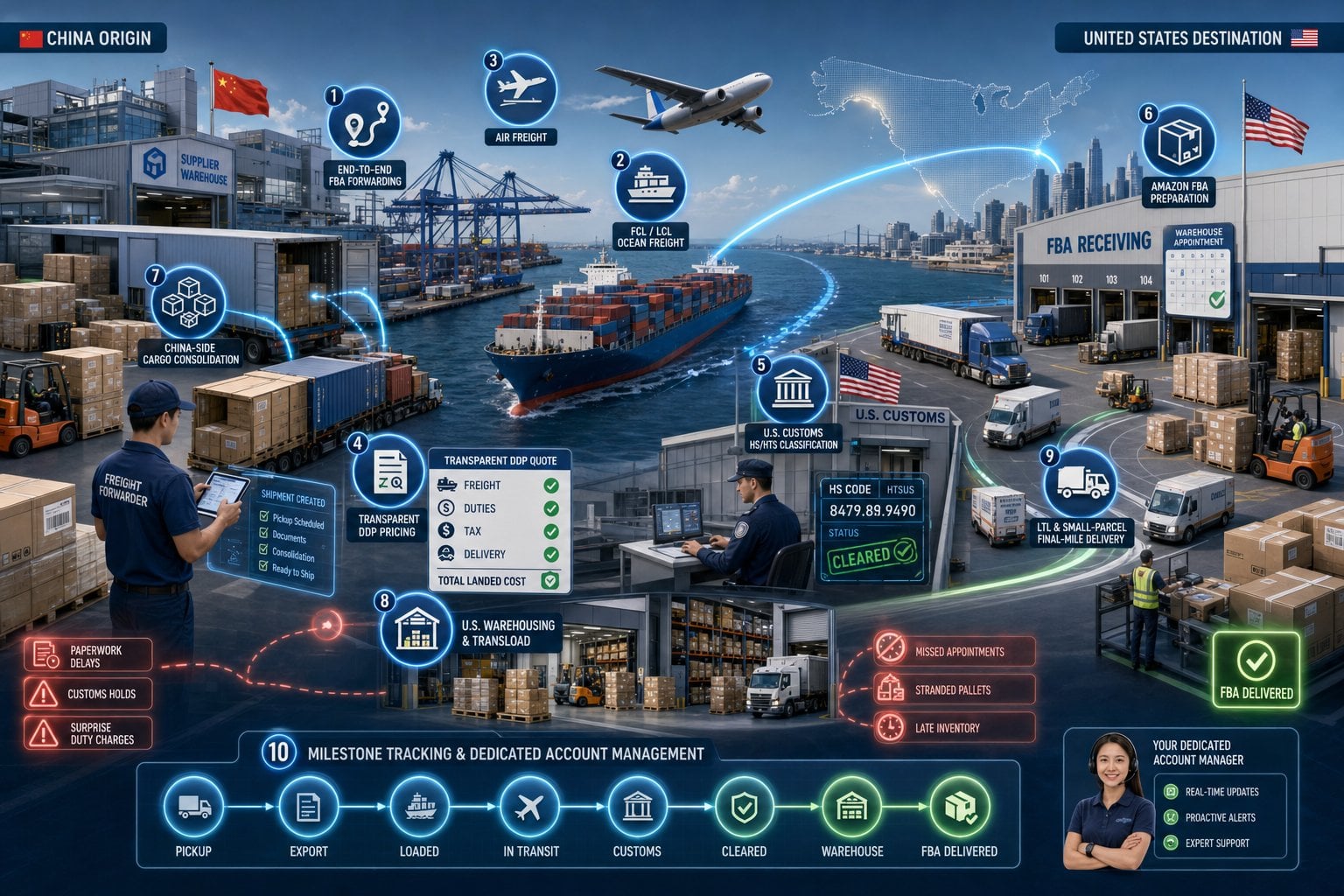
The process starts when a truck collects your cargo from the supplier’s factory or warehouse in China. From there, goods move to a port or airport, clear export customs, cross by ocean or air, clear US import customs, and get trucked to your door.
Export documentation errors cause a meaningful share of shipping delays, with incorrect paperwork linked to roughly 30% of hold-ups according to World Trade Organization data cited in an overview of door-to-door logistics. That’s why the pickup and export clearance stages deserve as much attention as the ocean or air leg itself.
Door-to-Door Shipping vs. Port-to-Port Service
Port-to-port service ends at the US port of arrival, leaving you to arrange customs clearance, drayage, and inland delivery yourself. Door-to-door shipping folds all of that into one coordinated service with a single point of contact.
The convenience carries a cost premium, but it also removes coordination risk. You’re not managing five separate vendors and hoping their timelines line up.
Costs That May Be Included or Excluded
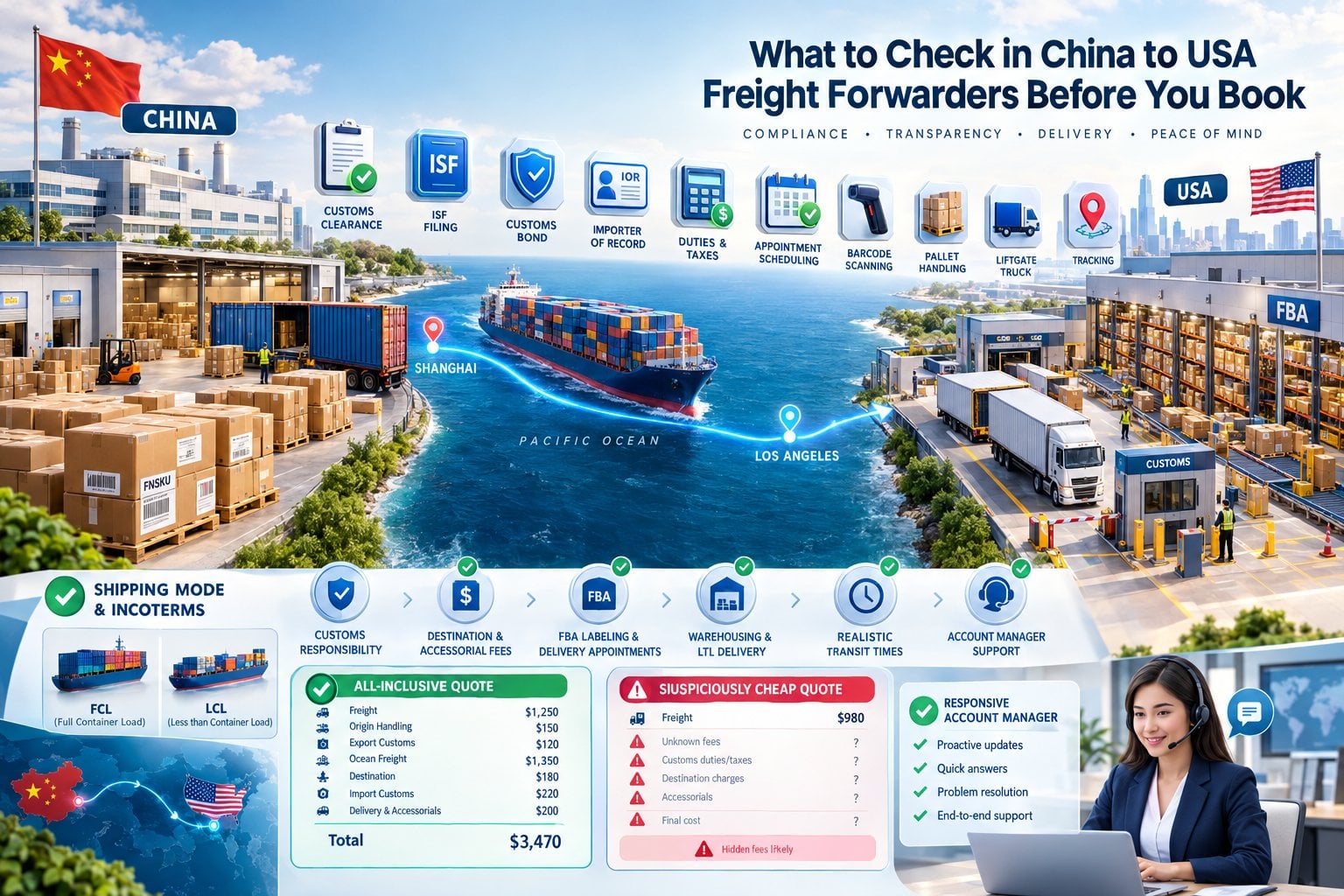
Total shipping costs can vary wildly depending on service inclusions. Before you compare two quotes side by side, check whether each one includes:
Customs brokerage and entry filing
Port handling and terminal fees
Cargo insurance
Inland trucking to your specific ZIP code
Liftgate or residential delivery accessorials
Duties and tariffs (often excluded and billed separately)
AEB Logistics, for example, structures its quotes around a single price with an itemized breakdown available on request, and it bundles customs brokerage support into shipment quotes for around $125 depending on the number of commodities. Ask any forwarder for that same level of detail on your door-to-door shipping quote before you book.
RELATED China to USA Shipping Cost: 2026 Rate Guide and Factors Affecting Freight Prices
How Much Do Air, Ocean, and Express Options Cost?
Air freight, ocean freight, and express courier services occupy three different price tiers, and the right one depends on your cargo’s weight, volume, and urgency. Moving cargo via sea freight offers the lowest cost per unit for bulk inventory. Air freight sits in the middle with faster transit, while express courier services cost the most per kilogram.
Air Freight Rates and Chargeable Weight
Air freight from China to the USA is priced by chargeable weight, which is whichever is higher: the actual weight of your cargo or its volumetric weight. Light but bulky cargo gets charged by volume rather than scale weight, so packaging efficiency directly impacts your freight invoice.
Shipments departing key origin hubs like PVG, SZX, or HKG connect quickly to major US gateways such as ORD or JFK. AEB Logistics notes that an air shipment from Hong Kong to Los Angeles can take around five days, while general Amazon FBA guidance estimates 7 to 10 days. Air freight makes the most sense for higher-value or time-sensitive cargo.
Ocean Freight Costs for FCL and LCL Cargo
Ocean freight is quoted differently depending on whether you need a Full Container Load (FCL) or Less than Container Load (LCL) space. Standard FCL options include a 20ft container, a 40ft container, and 40-foot high-cube containers, and you pay for the whole container regardless of how full it is.
LCL shipping charges you by the cubic meter (CBM) your cargo occupies inside a shared container. This makes LCL a practical fit for smaller shipments that don’t justify a dedicated container, while FCL usually delivers a lower cost per unit once your volume grows large enough to fill most of a container.
Express Courier Pricing for Small Parcels
Express courier services from providers like DHL, FedEx, and UPS charge the highest rate per kilogram of any shipping mode, but they also move fastest, often in a matter of days rather than weeks. AEB Logistics’ published estimates put express courier transit at approximately 3 to 5 days, compared to roughly 8 to 10 days for standard air freight and 30 to 40 days for door-to-door ocean freight.
Express pricing makes sense for samples, urgent replenishment orders, or very small parcel counts where container or air freight minimums don’t apply.
How to Use Rate Ranges Without Mistaking Them for Fixed Quotes
Published rate ranges are planning tools, not binding prices. Freight rates shift with fuel costs, carrier capacity, and seasonal demand, so the number you see in a rate guide today may not match the number on your invoice next month.
Treat any online rate table as a starting point for budgeting. Confirm the real number in writing from your forwarder once you have actual cargo dimensions, weight, and a cargo-ready date.
RELATED Freight Shipping from China to USA: Methods, Costs & Key Steps
Which Freight Method Offers the Best Value for Your Cargo?
The best value depends on your shipment’s size, weight, and how urgently you need it delivered, not on which mode has the lowest headline rate. A method that looks cheap per kilogram can turn expensive once minimum charges, accessorials, and delivery timelines are factored in.
When Air Freight Is Worth the Higher Cost
Air freight earns its premium when speed protects revenue, such as restocking a bestselling Amazon FBA listing before inventory runs out. For sellers managing Amazon FBA shipping, tight replenishment windows at an Amazon fulfillment center mean faster air transit can prevent lost sales that easily outweigh the extra freight expense.
When LCL Consolidation Is the Better Choice
LCL consolidation fits shipments too small to fill a container but too large for parcel courier limits. Cargo consolidation lets multiple shippers share container space, and deconsolidation at the destination warehouse separates individual orders before final delivery.
For Amazon FBA shipments arriving LCL, AEB Logistics can schedule delivery appointments once goods reach its destination-country warehouse, which keeps the process moving without requiring a dedicated container.
When a Full Container Load Lowers Cost per Unit
Full container load shipping brings your cost per unit down once your cargo approaches container capacity, since you’re not paying a per-CBM consolidation premium. It also reduces handling touches, cargo often stays sealed in the same container from factory to destination, lowering damage risk for fragile or high-volume goods headed to a distribution center.
When Express Shipping Makes Sense
Express shipping through DHL, FedEx, or UPS suits small parcels, product samples, or urgent parts orders where transit time matters more than per-kilogram cost. It rarely makes financial sense for full pallet quantities or bulk inventory replenishment, where ocean or air freight rates scale better.
| Shipping Mode | Best For | Typical Transit Time |
|---|---|---|
| Ocean FCL | Large-volume, full container quantities | ~30-40 days door to door |
| Ocean LCL | Mid-size shipments, shared container space | ~30-40 days door to door |
| Air Freight | Time-sensitive or high-value cargo | ~7-10 days |
| Express Courier | Small parcels, samples, urgent orders | ~3-5 days |
For sellers preparing FBA labels or pallet labels ahead of delivery, coordinating labeling with your forwarder before goods arrive at the fulfillment center or distribution center helps avoid appointment delays.
RELATED Sea Shipping Costs China to USA: 2026 Rates, Fees, and Strategies
What Drives Your Final Landed Cost?
Your final landed cost is the freight rate plus duties, taxes, fees, and delivery charges, and it’s almost always higher than the base shipping quote you see first. Landed cost calculations that skip duties, the Merchandise Processing Fee, or inland delivery charges routinely understate what an importer actually pays, with first-time importers underestimating true landed cost by 30 to 50% according to a breakdown of full landed cost components.
Cargo Dimensions, Weight, and Packaging
Chargeable weight and CBM directly set your freight rate, whether you’re shipping air, FCL, or LCL. Poorly packed cargo that wastes container space or triggers dimensional weight charges on air shipments adds cost without adding value, so accurate box counts, weights, and dimensions matter when you request a quote.
Route, Destination ZIP Code, and Inland Delivery Conditions
Inland trucking rates vary by destination ZIP code, and locations without a loading dock often require liftgate service. AEB Logistics lists a stated liftgate fee of $100, with residential deliveries and pickups carrying additional accessorial charges. Confirm these details before you commit to a delivery address, since they rarely show up in a headline freight rate.
Duties, Taxes, and Tariff Exposure
Import duties, customs duties, Section 301 tariffs on certain Chinese-origin goods, and the Merchandise Processing Fee (MPF) apply on top of your freight cost. Importers remain legally responsible for duties and taxes regardless of which Incoterm handles the cargo. Because Amazon does not act as Importer of Record for FBA shipments, unpaid duties can block delivery entirely.
Seasonal Demand, Fuel, and Port Disruption Costs
Fuel surcharges and peak season surcharges shift with carrier capacity and demand cycles, often spiking around major shopping seasons. Port congestion adds unpredictable delays and cost on top of base freight rates, so building in a buffer for peak-season timing protects your delivery schedule.
RELATED Container Shipping Costs China to USA: Complete 2026 Guide
How Do DDP, DAP, and Other Incoterms Change the Price?
Incoterms determine who pays for freight, duties, and clearance at each stage of the shipment, and picking the wrong one shifts costs and legal responsibility onto you unexpectedly. DDP (Delivered Duty Paid) and DAP (Delivered at Place) are the two terms most commercial importers compare when structuring a China-to-USA shipment.
Delivered Duty Paid: What a DDP Quote Should State
When booking DDP shipping, your DDP quote should state clearly, in writing, that duties, taxes, and delivery to your final address are included in the price. Delivered duty paid terms shift import clearance and duty payment onto the forwarder or seller. However, buyers remain legally responsible if customs declarations are inaccurate.
Delivered at Place: Which Charges the Importer Pays
Under DAP, the seller delivers goods to your named location, but you’re responsible for import clearance, duties, and taxes once the shipment reaches the destination country. This gives importers more direct control and visibility over duty calculations, though it also means budgeting separately for customs costs rather than folding them into a single quoted price.
FOB, EXW, and CIF: Where Cost Responsibility Begins
FOB (Free on Board) means the seller’s responsibility ends once goods are loaded onto the vessel at the origin port, with the buyer covering freight and insurance from there. EXW (Ex Works) shifts even more responsibility to the buyer, who arranges pickup from the factory itself. CIF (Cost, Insurance, Freight) has the seller cover freight and insurance to the destination port, but the buyer still handles duties, customs clearance, and delivery from port to door, as outlined in this explanation of landed cost components under CIF terms.
Why the Importer of Record Must Be Clear
Every shipment needs a clearly named Importer of Record (IOR) responsible for duties, taxes, and compliance with US Customs and Border Protection. A customs bond, whether an annual bond or a single-entry bond, secures that obligation, and a Power of Attorney is required whenever a broker or forwarder is authorized to file customs entries on your behalf.
RELATED Essential Guide to Shipping from China to USA: Optimize Your Logistics
Which Documents and Customs Steps Can Affect Delivery Costs?
Missing or inaccurate documents cause customs holds, storage fees, and delivery delays that add real cost to a shipment. Getting the paperwork right before cargo ships is one of the cheapest ways to control your final landed cost.
Commercial Invoice, Packing List, and Product Classification
The commercial invoice and packing list must match the actual cargo, including accurate descriptions, values, and HS codes. Many products also require a certificate of origin to verify manufacturing provenance and determine duty rates. A bill of lading, air waybill, or carrier airway bill must match this documentation exactly to prevent border holds.
ISF Filing Requirements for Ocean Imports
Ocean shipments to the US require an Importer Security Filing (ISF, sometimes called ISF 10+2) submitted to CBP before cargo loads at the origin port. Missing or late ISF filings can trigger CBP penalties and cargo holds, so this filing needs to happen early in the shipping timeline, not as an afterthought once goods are already at sea.
Customs Clearance, Bonds, and Duty Payment
Customs brokerage support typically costs around $125 per shipment depending on commodity count, according to AEB Logistics’ published pricing structure. A customs bond, either arranged annually or provided by the broker on a case-by-case basis, guarantees duty payment to CBP, and a Power of Attorney authorizes your broker to file the entry.
How Accurate Shipment Data Prevents Delays and Extra Charges
Providing your forwarder with accurate origin and destination addresses, Incoterms, HS codes, cargo value, box count, CBM, weight, and cargo-ready date up front prevents quote discrepancies later. This same accuracy prevents customs delays once goods are moving, since CBP holds on misdeclared cargo often cost more in storage fees than the shipment’s original freight charge.
RELATED Door-to-Door Shipping China to USA Case Study: Real-World Insights and Lessons
Frequently Asked Questions
How much does door-to-door shipping from China to the USA cost per kg?
Cost per kilogram varies by mode: express courier rates run highest, air freight sits in the middle, and ocean freight (FCL or LCL) offers the lowest per-kilogram cost for bulk cargo. Treat any published per-kg figure as a planning range and confirm the actual number with your forwarder based on your cargo’s weight, volume, and destination ZIP code.
What is the cheapest way to ship commercial cargo from China to the USA?
Ocean freight, particularly FCL when your volume approaches a full container, generally delivers the lowest cost per unit for commercial cargo. LCL consolidation works well for smaller shipments that don’t justify a dedicated container, while air and express modes cost more but move faster.
How much does it cost to ship a 40-foot container from China to the USA?
Container rates depend on the origin port, destination port, carrier, and current market demand, so no single fixed price applies across all shipments. Request a quote based on your specific route and cargo-ready date, since container rates shift with fuel surcharges and seasonal demand.
Do I pay tariffs and import duties when shipping from China to the USA?
Yes, importers remain legally responsible for duties, taxes, and any applicable Section 301 tariffs regardless of which Incoterm or forwarder handles the shipment. Amazon does not act as Importer of Record for FBA shipments, so unpaid duties or taxes can prevent delivery to a fulfillment center.
How long does door-to-door shipping from China to the USA take?
Transit time depends on the mode: express courier runs about 3 to 5 days, standard air freight about 8 to 10 days, and door-to-door ocean freight about 30 to 40 days according to AEB Logistics’ published estimates. Actual times shift with customs processing, port congestion, and carrier schedules.
Is DHL, FedEx, or UPS cheaper than air freight for small shipments?
For very small parcels or low-weight shipments, express couriers like DHL, FedEx, and UPS can be cost-competitive with air freight once minimum air freight charges are factored in. Once shipment weight climbs past a few dozen kilograms, standard air freight rates typically become the lower-cost option.
Related Posts
Door-to-Door Shipping Rates China to USA: Costs, Methods, and Key Considerations
Door-to-Door Shipping Quotes China to USA: Complete Guide & Cost Factors
China to USA Shipping Cost: 2026 Rate Guide and Factors Affecting Freight Prices
Freight Shipping from China to USA: Methods, Costs & Key Steps
Sea Shipping Costs China to USA: 2026 Rates, Fees, and Strategies