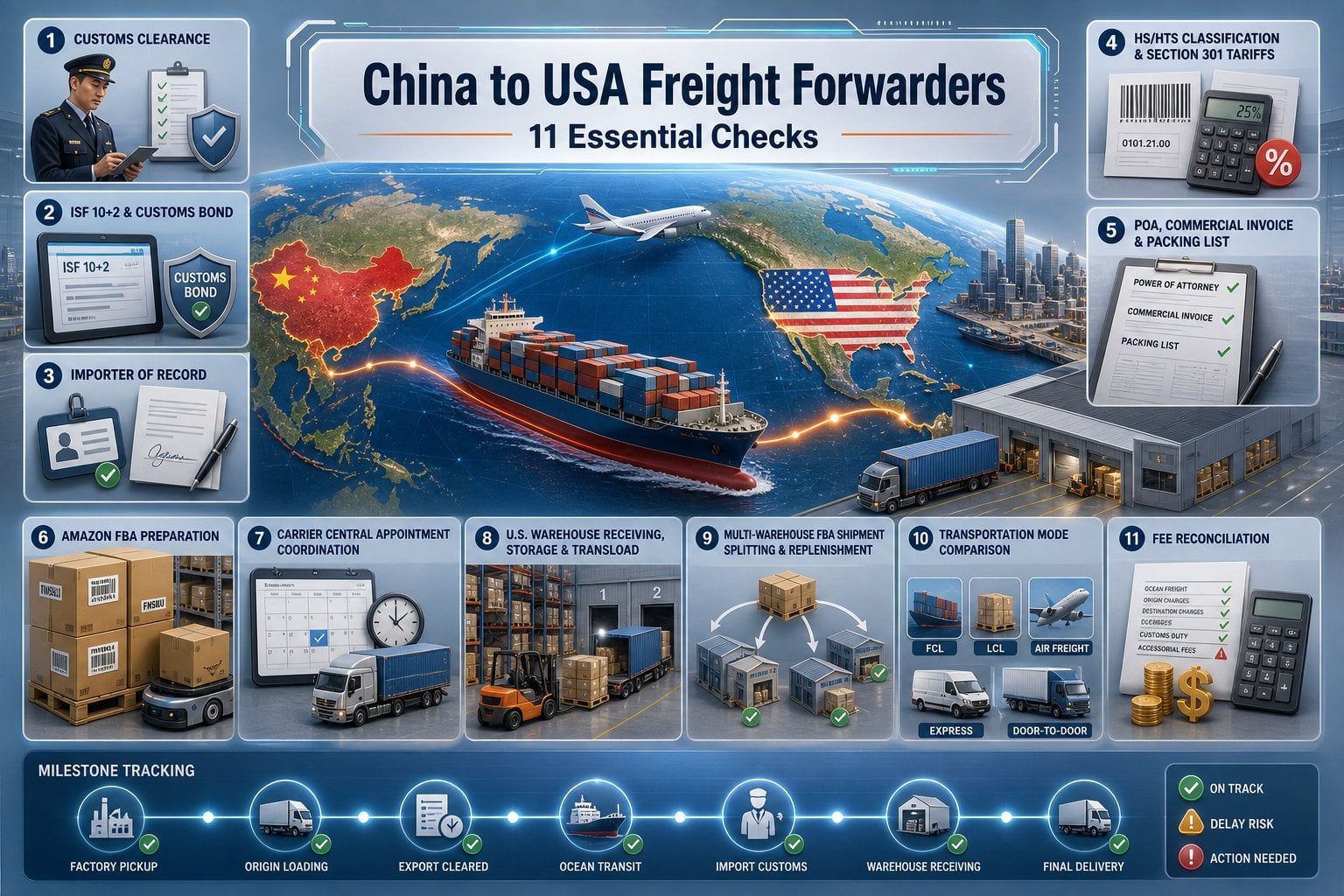
China To USA Freight Forwarders: 11 Essential Checks
Choosing between China to USA freight forwarders gets confusing fast once you start collecting quotes. Two proposals can look almost identical on price, yet expose you to totally different risks at customs, in the warehouse, or at your Amazon FBA delivery appointment.
Before you compare rates side by side, check the specific responsibilities each forwarder actually takes on—not just the number on their quote sheet. A low headline rate that skips customs bond coverage, ISF filing, or FBA labeling can cost you more in delays and rework than a slightly higher all-in price.
This checklist walks through the 11 practical checks worth running before you sign with any freight forwarding company. Each one focuses on a spot where importers often get surprised: customs clearance, Amazon FBA logistics, warehousing, and the fine print around fees.
Work through them with your shipment details in hand. You’ll be in a much stronger position to compare freight forwarders on substance instead of guesswork.
Contents hide
1 Verify CBP Entry Filing, ISF 10+2, And Customs Bond Responsibility
2 Confirm Who Will Be The U.S. Importer Of Record
3 Test HS/HTS Classification And Section 301 Tariff Expertise
4 Check Power Of Attorney, Commercial Invoice, And Packing List Controls
5 Audit Amazon FBA Prep For FNSKU, Carton, And Pallet Labels
6 Confirm Amazon Carrier Central Appointment Coordination
7 Inspect U.S. Warehouse Receiving, Storage, And Transload Capability
8 Verify Multi-Warehouse FBA Shipment Splitting And Replenishment Support
9 Match FCL, LCL, Air Freight, Express, And Door-To-Door Options
10 Reconcile Origin Charges, Destination Charges, Duties, And Accessorial Fees
11 Check Milestone Tracking From Factory Pickup To Final Delivery
12 How To Compare Like-For-Like Forwarder Proposals
12.1 Use The Same Origin, Destination, Incoterms, Cargo Value, And Cargo-Ready Date
12.2 Separate Freight Costs From Duties, Taxes, Insurance, And Optional Services
12.3 Compare The Scope Of Responsibility Rather Than The Lowest Headline Rate
13 How To Make A Confident Final Selection
13.1 Prioritize The Risks That Could Disrupt Your Specific Supply Chain
13.2 Request Written Confirmation Of Assumptions And Exclusions
13.3 Start With A Manageable Shipment Before Scaling Volume
14.1 What factors should I compare when choosing a freight forwarder from China to the USA?
14.2 Which freight forwarder is best for shipping goods from China to the USA?
14.3 How much does it cost to ship freight from China to the USA?
14.4 How can I verify that a China-to-USA freight forwarder is legitimate and reliable?
https://www.youtube.com/watch?v=6xFxS_-yP7I
Verify CBP Entry Filing, ISF 10+2, And Customs Bond Responsibility
Ask directly who files your entry with U.S. Customs and Border Protection (CBP) and who submits the Importer Security Filing, known as ISF 10+2. This filing is required for ocean cargo and must go in at least 24 hours before your container loads at the Chinese port.
Missing this deadline can trigger CBP penalties and hold your shipment at the port. Confirm whether the forwarder carries a customs bond or expects you to secure your own.
A bond guarantees payment of duties and fees to CBP, and shipments without one can be refused entry. Some forwarders offer use of their own bond on a case-by-case basis, which can simplify onboarding for newer importers.
Get this in writing before your cargo ships, not after it arrives at port. Ask who is liable if the ISF filing is late or inaccurate.
If a forwarder can’t clearly answer these questions, keep looking. It’s not worth the risk.
RELATED China to USA Freight Forwarders: 9 Quote Checks Before You Ship
Confirm Who Will Be The U.S. Importer Of Record
The Importer of Record (IOR) is the party legally responsible for making sure a shipment complies with U.S. laws and that duties and taxes get paid. In almost every case, that’s you—the buyer—not the freight forwarder and definitely not Amazon.
Confirm this in writing before you ship. Amazon doesn’t act as Importer of Record for FBA shipments and will refuse cargo that arrives with unpaid duties, taxes, or freight charges.
If your forwarder suggests otherwise, get clarity immediately. Some forwarders offer to act as an agent for documentation, but the legal liability for compliance usually stays with the actual importer.
Ask what happens if CBP flags a valuation or classification issue after entry. Find out who absorbs penalties versus who just forwards the paperwork.
RELATED Freight Forwarding Services: Comparing China–USA Providers
Test HS/HTS Classification And Section 301 Tariff Expertise
Every product entering the U.S. needs a Harmonized System (HS) or Harmonized Tariff Schedule (HTS) code. This code determines your duty rate, and getting it wrong can mean overpaying or facing penalties for underpayment.
Ask your forwarder to classify a sample product from your catalog and explain their reasoning. A knowledgeable team should reference the product’s material, function, and use—not just guess based on similar items.
Electronics typically carry duty rates of 2 to 6 percent, while apparel can reach 16 to 20 percent. Classification accuracy directly affects your landed cost.
Section 301 tariffs add extra duties on many Chinese-origin goods, layered on top of standard rates. Confirm your forwarder tracks which of your products fall under these tariffs and can explain the current rate.
If they treat classification as an afterthought, they’ll likely cost you money at the border.
RELATED China-USA Freight Forwarding: 8 Questions to Ask Before Choosing a Provider
Check Power Of Attorney, Commercial Invoice, And Packing List Controls
A Power of Attorney (POA) authorizes your forwarder or customs broker to file documents with CBP on your behalf. Confirm exactly what authority you’re granting and for how long.
Some POAs cover a single shipment, others stay active indefinitely. Review how the forwarder handles your commercial invoice and packing list.
These documents need accurate product descriptions, quantities, values, and HS codes. Errors here are a leading cause of customs delays and audits.
Ask who double-checks these documents before filing. If the forwarder just passes along whatever the supplier sends—without review—you’re on the hook for compliance.
Look for a process where someone verifies values and descriptions against your purchase order before submission to CBP. It’s a simple step that can save you a lot of headaches.
RELATED China to USA Freight Forwarders: 2026 Comparison, Costs, and Best Services
Audit Amazon FBA Prep For FNSKU, Carton, And Pallet Labels
Amazon has strict labeling rules. Mistakes here cause rejected shipments or delivery delays at fulfillment centers.
Ask your forwarder how they handle FNSKU labels, which identify individual products for Amazon’s system. Confirm they also manage carton and pallet labels according to Amazon’s current requirements.
Amazon’s rules on labeling formats and placement change periodically, so ask how their team keeps up. Request examples of past FBA prep work or a walkthrough of their labeling process.
Do they inspect products before labeling to catch damaged or mismatched inventory early? A forwarder experienced in Amazon FBA logistics should describe this process clearly, using specifics—not just vague reassurances.
RELATED Freight Forwarder China To USA: Essential Guide For Efficient International Shipping
Confirm Amazon Carrier Central Appointment Coordination
Amazon requires delivery appointments for most FBA shipments, scheduled through its Carrier Appointment Request Portal. Missing or mismanaged appointments can delay your inventory reaching sellable status by days or even weeks.
Ask your forwarder who books this appointment and how far in advance. For less than container load (LCL) shipments, appointments usually get scheduled once your cargo arrives at the forwarder’s destination warehouse, not before.
If you plan to use your own carrier, confirm the forwarder can still coordinate the appointment when given your bill of lading, Amazon FBA booking form, and carrier manual. Ask what happens if Amazon reschedules or rejects an appointment.
A forwarder with hands-on Carrier Central experience will explain rescheduling steps clearly instead of treating it as someone else’s problem.
RELATED China to USA Freight Forwarders: Compare Top Logistics Partners for 2026
Inspect U.S. Warehouse Receiving, Storage, And Transload Capability
Ask where your forwarder’s U.S. warehouse facilities are located and whether they operate their own space or lease through a third party. Third-party warehouse arrangements can still provide stable rates and a real local address for shipping, which matters for FBA sellers who need to hold inventory outside Amazon.
Confirm receiving procedures. Ask how incoming cargo gets checked against your packing list and what happens if a carton is damaged or missing.
Check whether the facility supports transload services—meaning cargo moves from an ocean container into a domestic truck for final delivery. This matters if your shipment needs to split across multiple destinations or switch trailer types.
Ask about typical dwell time, meaning how long cargo sits before it moves again. Long dwell times quietly add cost and delay to your supply chain.
RELATED Ultimate Guide: Finding the Best Freight Forwarder from China to the USA
Verify Multi-Warehouse FBA Shipment Splitting And Replenishment Support
Amazon frequently splits a single FBA shipment across multiple fulfillment centers. Your forwarder needs a system for dividing cargo accurately.
Ask how they handle this process and whether splitting happens at their warehouse or gets outsourced. Confirm they can manage inventory replenishment too—restocking fulfillment centers over time instead of shipping everything at once.
This matters if you sell steadily and need predictable inflow. Ask about their error rate on split shipments and how they correct mistakes when cartons go to the wrong warehouse.
If a forwarder can’t answer clearly here, they may struggle once your order volume grows beyond a single pallet.
Match FCL, LCL, Air Freight, Express, And Door-To-Door Options
Confirm your forwarder offers the shipping modes that fit your actual volume—not just the ones they prefer to sell. Full Container Load (FCL) suits larger shipments needing a dedicated 20-foot or 40-foot container.
LCL works better for smaller loads under roughly 15 cubic meters, where you share container space and pay per unit of volume. Air freight moves cargo faster, generally landing in 7 to 10 days compared to several weeks by ocean, but at a higher price per kilogram.
Express courier services suit urgent, smaller shipments needing door-to-door speed. Ask whether door-to-door and Delivered Duty Paid (DDP) options are available, since these bundle customs and inland delivery into a single service.
Match the option to your cargo-ready date and budget. Don’t just default to whatever mode a forwarder pushes first.
RELATED China to USA Freight Forwarders: 9 Quote Checks Before You Ship
Reconcile Origin Charges, Destination Charges, Duties, And Accessorial Fees
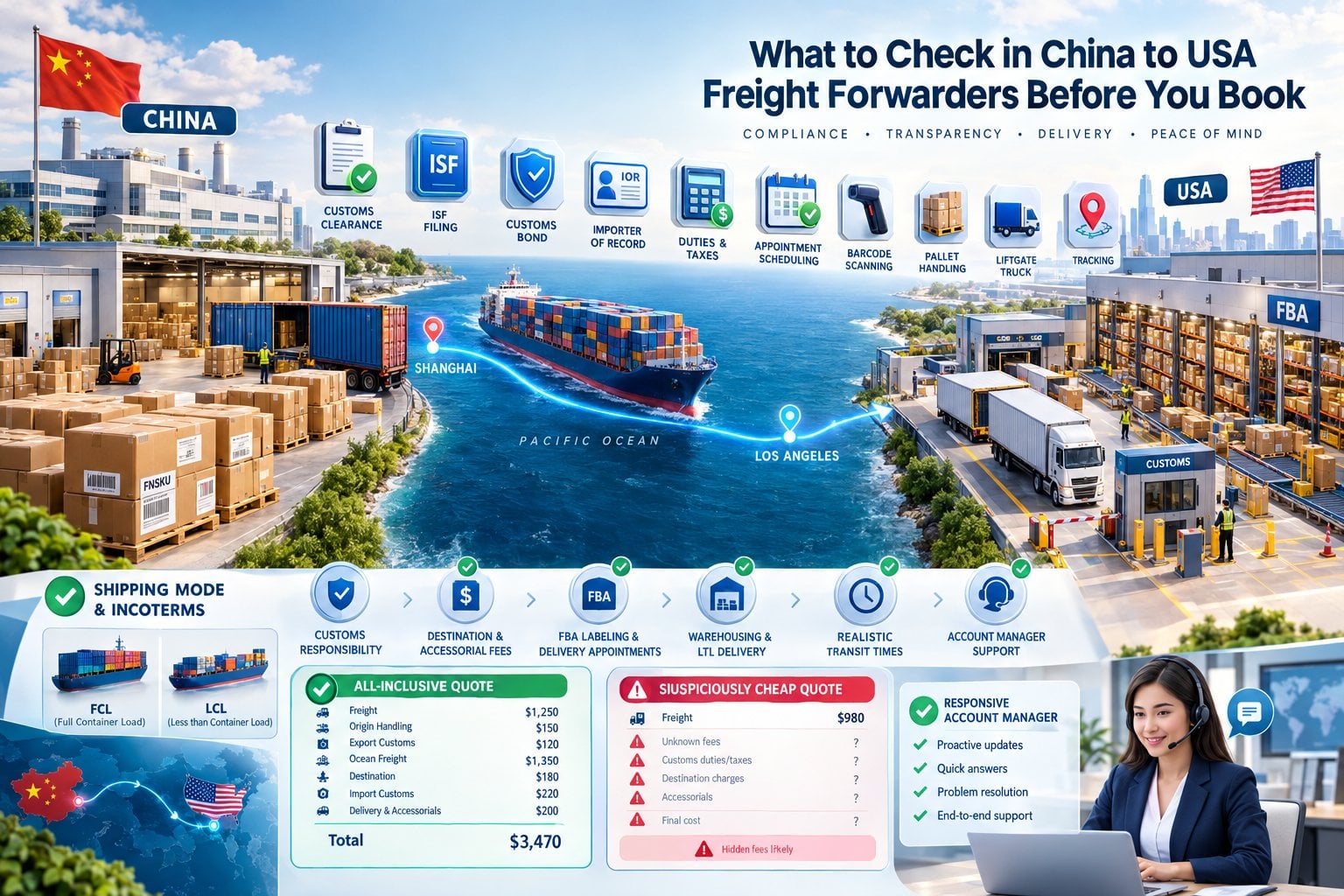
Request an itemized breakdown covering origin charges in China, ocean or air freight, destination charges at the U.S. port, and inland delivery. Vague “all-in” quotes often hide gaps that surface later as unexpected invoices.
Ask specifically about accessorial fees—extra charges for services like liftgate delivery at locations without a loading dock, often around $100, or residential delivery surcharges. Confirm whether customs brokerage is included or billed separately, since brokerage support typically runs around $125 depending on how many commodities you’re importing.
Remember, duties and taxes remain your responsibility as the importer, regardless of what the forwarder’s invoice covers. Ask for a full landed cost estimate—not just a freight quote—so you can compare offers on equal footing.
RELATED Freight Forwarding Services: Comparing China–USA Providers
Check Milestone Tracking From Factory Pickup To Final Delivery
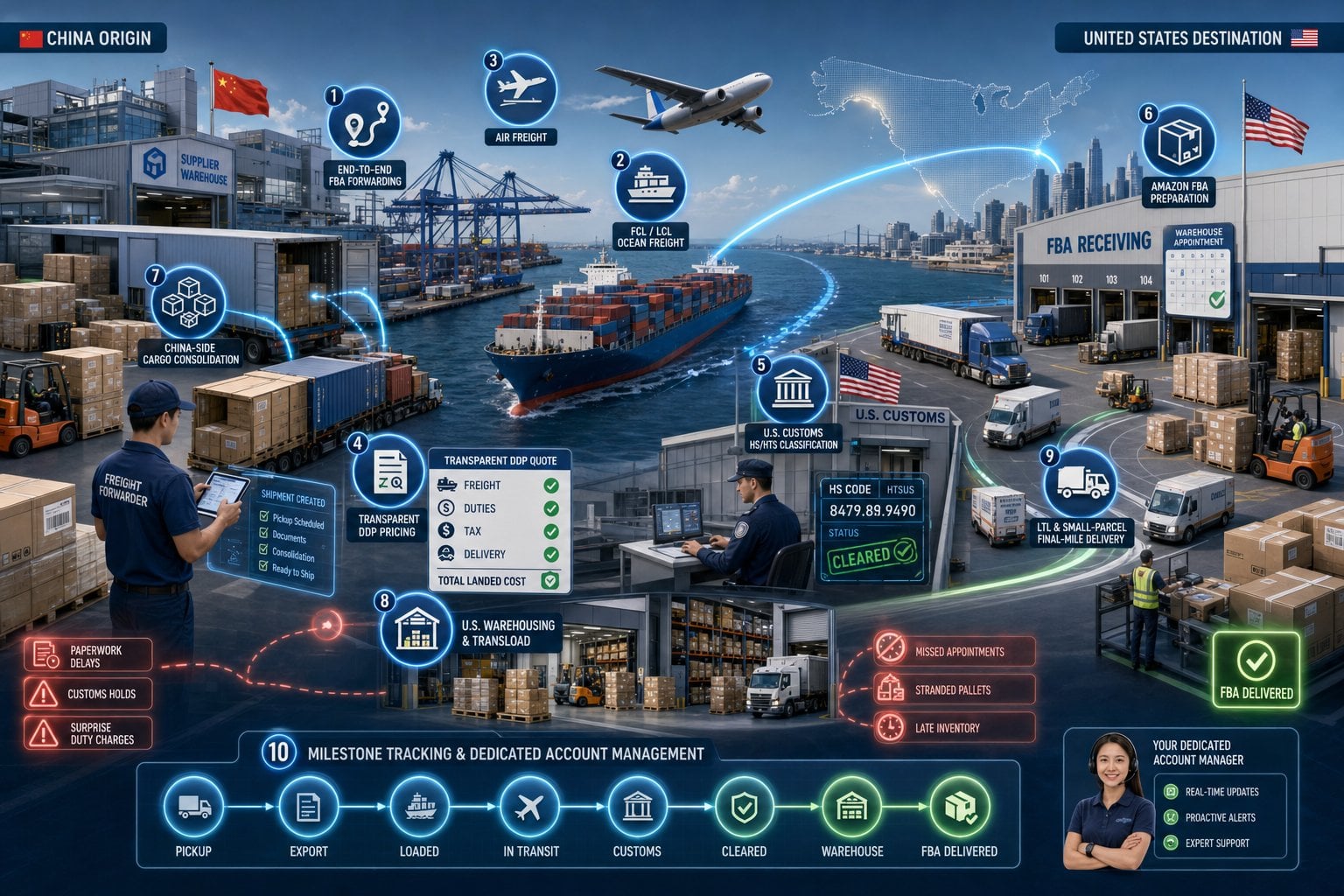
Ask what tracking system the forwarder uses and how often it updates. A reliable system should show clear milestones: accepted, in transit, export customs, export departure, import entry, import arrival, and delivered.
Confirm whether you get proactive alerts when a shipment status changes or if you have to log in and check manually. Also ask who you contact when something goes wrong between milestones.
Gaps in communication during delays are where relationships with forwarders tend to break down. A forwarder offering a dedicated account manager alongside tracking gives you a direct line for questions instead of a generic support inbox.
Test their responsiveness before committing to a full shipment. Better to know now than when your cargo is already at sea.
RELATED China-USA Freight Forwarding: 8 Questions to Ask Before Choosing a Provider
How To Compare Like-For-Like Forwarder Proposals
Use The Same Origin, Destination, Incoterms, Cargo Value, And Cargo-Ready Date
Send every forwarder the exact same shipment details: same origin and destination, same Incoterms like FOB or EXW, same cargo value, and the same cargo-ready date. Even small differences in these inputs can change the quote enough to make comparisons pointless.
Write out your HS code, box count, cubic meters, and weight once. Paste the same info into each request to keep things consistent and cut out guesswork.
Separate Freight Costs From Duties, Taxes, Insurance, And Optional Services
Break every quote into its parts before you look at totals. List freight cost, customs brokerage, duties, insurance, and any extras like warehousing or FBA prep as separate line items.
If a quote bundles everything together, it’s tough to see which parts are fair and which are padded. Once you split it up, you can spot who’s charging a fair freight rate but maybe overcharging for brokerage, or vice versa.
Compare The Scope Of Responsibility Rather Than The Lowest Headline Rate
The cheapest quote on paper often skips services another forwarder includes by default, like ISF filing, FBA labeling, or delivery at destination. Ask each forwarder for a written list of exactly what their price covers and what could trigger extra charges.
A recent comparison guide on quote checks points out that cheap quotes usually look good only because they leave out steps a competing quote includes. Weigh the full scope against the total price, not just the price alone.
RELATED China to USA Freight Forwarders: 2026 Comparison, Costs, and Best Services
How To Make A Confident Final Selection
Prioritize The Risks That Could Disrupt Your Specific Supply Chain
Rank the risks that matter most for your business. If you sell only through Amazon FBA, labeling accuracy and appointment scheduling are way more important than general warehouse space.
If you import regulated goods, customs classification expertise should be your top concern. Match your priorities to each forwarder’s real strengths, not just their marketing claims.
Request Written Confirmation Of Assumptions And Exclusions
Get every assumption in writing before you book. Ask for a document listing what’s included, what’s excluded, and what triggers extra fees.
Verbal assurances during a sales call rarely hold up if a dispute comes up later. This written record protects you if a shipment runs into problems and gives you something solid to compare against another forwarder’s terms.
Start With A Manageable Shipment Before Scaling Volume
Test a new forwarder with a smaller shipment before you commit your full volume. This limits your risk while you see how they actually perform—communication speed, paperwork accuracy, and how they handle a problem if one pops up.
Once you’ve confirmed reliable service with a smaller load, you can scale up with more confidence and maybe negotiate better rates.
RELATED Freight Forwarder China To USA: Essential Guide For Efficient International Shipping
Frequently Asked Questions
What factors should I compare when choosing a freight forwarder from China to the USA?
Compare customs brokerage strength, warehouse locations, Amazon FBA experience, pricing transparency, and tracking capability. Make sure each forwarder explains who handles ISF filing, customs bonds, and duty payment before you commit.
Which freight forwarder is best for shipping goods from China to the USA?
There’s no single best forwarder for everyone. The right choice depends on your shipment size, product type, and whether you need Amazon FBA support.
Compare forwarders against the specific checks in this guide, then match their strengths to your real shipping needs.
How much does it cost to ship freight from China to the USA?
Costs vary by mode and volume. Recent sea freight rates show 20-foot containers running about $5,400 to $6,600.
LCL runs around $130 per cubic meter, and air freight often goes over $7 per kilogram before surcharges and destination fees.
How can I verify that a China-to-USA freight forwarder is legitimate and reliable?
Check their business registration status. Ask for proof of customs bond or brokerage credentials, and confirm membership in recognized networks like the Amazon Service Provider Network if you ship FBA.
Request references or examples of past shipments similar to yours. It never hurts to double-check.
Should I choose sea freight, air freight, rail freight, or express shipping for shipments to the USA?
Sea freight works best for larger, less urgent shipments and offers the lowest per-unit cost. Air freight and express are better for urgent or high-value cargo where speed matters more than price, with air typically taking 7 to 10 days versus several weeks by ocean.
What customs clearance, insurance, and destination fees should I check before selecting a freight forwarder?
Ask for itemized costs covering customs brokerage, import duties, cargo insurance, and destination charges like drayage or liftgate fees. Double-check if these are included in the base quote or if you’ll see them as separate charges later on.
Bundled and itemized pricing can look similar at first, but sometimes the details make a world of difference. It’s always worth asking upfront—no one likes surprise fees.